What Makes a Good Learning and Development Budget in 2026?

Updated April 2026

By Richard Parfitt (Marketing Director, iVentiv and author of the iVentiv Budget Report)

As an L&D leader, you are certainly not alone in wondering if your budget matches up to the expectations placed on you and your team. It’s no surprise that 60% of CLOs say measuring ROI is one of their top priorities.

But what makes a good L&D budget in 2026? How much should your organisation be spending? What figures should you be benchmarking against?

Download the iVentiv Budget Report today for a detailed breakdown of how much senior Learning and Talent Executives have at their disposal in 2026, including average budget per employee. The report also lays out what L&D’s biggest spenders and biggest employers are prioritising.
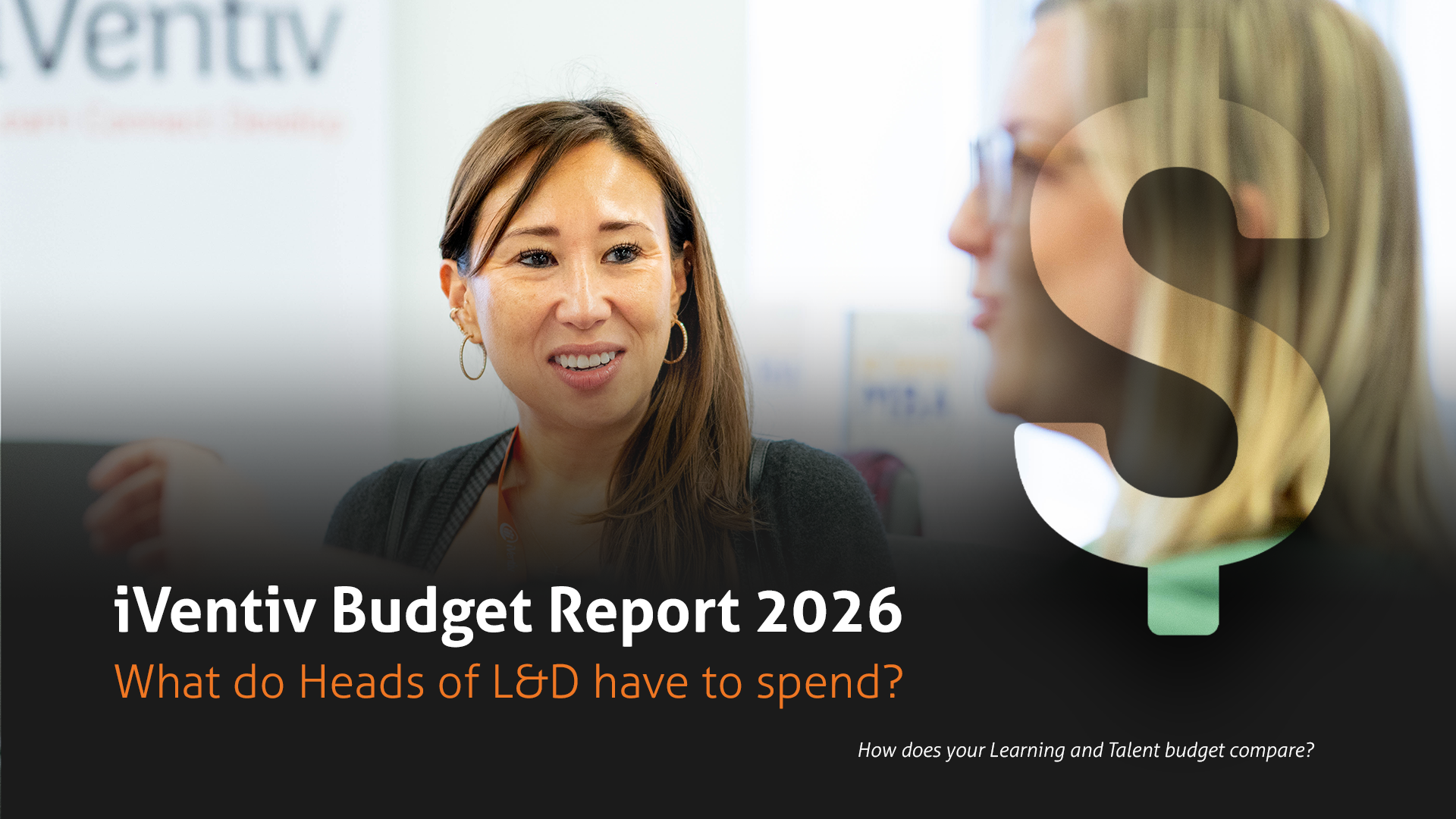
The cover of the iVentiv Budget Report 2026

Key Takeaways

  • The average L&D budget for senior leaders in 2026 is $11.8 million, with significant variation across organisations
  • Spend per employee differs widely, from over $1,700 in smaller organisations to under $300 in larger enterprises
  • CLOs with the largest budgets prioritise Future of Work, Skills, and Learning Platforms
  • The biggest employers place more emphasis on AI as a core L&D priority

What is the Average L&D Budget in 2026?

In terms of the headline number, the average L&D executive holds a budget of $11.8 million.

That’s based on survey responses from almost 500 global Heads of Learning & Development and Talent, from organisations with tens of thousands of employees on average. Each respondent completed a survey between April 2025 and March 2026 ahead of an iVentiv event for senior Learning and Talent leaders.

Respondents were asked to share the budget under their specific control, so that number may reflect the discretionary budget under the control of the individual Chief Learning Officer, rather than the absolute total spend on L&D.

That said, the spread is revealing, with around 50% of L&D leaders holding a budget of $1 million or more, and 6% over $100 million.

What is the Average L&D Spend Per Employee?

Survey respondents were also asked to share the number of employees or internal customers under their remit. Based on those responses, the average Learning spend per employee is $902.

Once again, there is a wide range of spending levels. Executives responsible for fewer than 5,000 employees manage an average total budget of $4.3 million, but a spend per employee of $1,735. In larger organisations, employing over 100,000 people, the average budget is over $25 million, but the spend per employee is $259.

Where do CLOs with the Biggest Learning & Development Budgets Spend Their Money?

What the report also shows is that the Executives with the biggest budgets are more likely to prioritise certain topics compared to their less well-resourced peers. Respondents with budgets of $100 million+ were more likely to be focusing on:

  • The Future of Work
  • Reskilling and Upskilling
  • Learning Platforms (LMS/LXP)

Learning leaders with the biggest budgets are concerned with designing work and the “skills needed for the future”, driving culture change in a scalable way amidst “persistent change”.

Where do the Biggest Employers Spend Their Learning & Development Budgets?

Pricing for many Learning products and platforms is based on a price per user, so it is worth asking where the biggest employers are most likely to focus their efforts and their money as well.

When it comes to how the biggest employers spend their Learning & Development budgets, Chief Learning Officers and Heads of Learning & Talent are more likely to focus on three key areas:

  • Artificial Intelligence (AI)
  • Learning Platforms (LMS/LXP)
  • Future of Work

The difference is especially striking when it comes to AI, with 74% of L&D budget holders at organisations with more than 100,000 employees saying that Artificial Intelligence is a top priority compared to only 54% at organisations with fewer than 5,000 employees.

Benchmark Your L&D Budget: Download the iVentiv Budget Report

The full iVentiv Budget Report includes a detailed breakdown of the different budgets managed by Learning & Development Executives. That includes figures on the average Learning budget per employee in organisations of different sizes, and how the top priorities for Chief Learning Officers change depending on the size of their budget and workforce.

Download the report for free today.

Frequently Asked Questions

What is an L&D budget?

An L&D budget (Learning & Development budget) refers to the total amount an organisation allocates to training and development activities over a set period, typically annually. This includes spending on leadership development, learning platforms (LMS/LXP), external providers, internal programmes, and workforce development initiatives. Understanding what an L&D budget is helps organisations plan how they invest in skills, performance, and long-term capability building.

What is a good learning and development budget in 2026?

A good learning and development budget depends on organisational size, industry, and strategic priorities. However, current benchmarks suggest that the average L&D budget for senior leaders is around $11.8 million. Rather than focusing solely on total budget, organisations should assess whether their budget for learning and development aligns with business goals, supports key initiatives like Artificial Intelligence and leadership development, and delivers measurable impact.

What is the average L&D budget per employee?

The average L&D budget per employee is approximately $902, based on recent data from global Learning & Development leaders. However, this figure varies significantly. Smaller organisations often invest more per employee, sometimes exceeding $1,500, while larger enterprises may spend closer to $250 per employee. Benchmarking your L&D spend per employee is essential to understand whether your investment is competitive and effective.

How do you calculate a training and development budget per employee?

To calculate a training and development budget per employee, divide your total L&D budget by the number of employees or learners in your organisation. For example, if your annual L&D budget is $10 million and you support 10,000 employees, your Learning & Development budget per employee would be $1,000. This metric is widely used to compare Learning budgets across organisations and to benchmark investment levels.

What should be included in a learning budget?

A comprehensive learning budget should include all costs associated with training and development. This typically covers:

  • Leadership development programmes
  • Learning platforms and technology (LMS/LXP)
  • External training providers and consultants
  • Internal programme delivery and resources
  • Content creation and curation
  • Workforce development initiatives

A well-structured L&D budget ensures that spending is aligned with both immediate training needs and long-term organisational capability.

How can you benchmark L&D budgets effectively?

Benchmarking L&D budgets involves comparing your spending against similar organisations in terms of size, industry, and geography. Key metrics include total Learning budget, L&D spend per employee, and investment in priority areas such as leadership development. Effective benchmarking goes beyond numbers. It also considers how budgets are allocated and whether spending supports strategic outcomes like reskilling, culture change, and digital transformation.

How does L&D spend impact ROI and business performance?

L&D spend plays a critical role in driving organisational performance, but ROI depends on how effectively the budget is used. Investment in training and development can improve employee engagement, productivity, retention, and leadership capability. To maximise ROI, organisations should align their Learning budgets with business priorities, focus on applied learning, and measure outcomes such as performance improvement and skill acquisition rather than just participation rates.
Thumbnail: 
News category: 
Learning & Development
ROI and Data
Latest Trends in Learning

More Insights

The topic of Artificial Intelligence has been impossible to escape in L&D over the past few years. For some, it stands to displace the entire function and render most of its skills and roles obsolete. For others, it represents an opportunity for Learning to reach more employees in more meaningful ways than ever before.

In this blog and report, we look in more detail at what Heads of Learning say they are really doing about AI

In a world where the shelf life of skills is shrinking from years to mere months, the question facing every Learning leader is no longer if we move to a skills-based model, but how fast. For Comcast, the answer has been a bold, enterprise-wide journey called Skill Forward.

Spearheaded by Sara Dionne, Chief Learning Officer at Comcast, Skill Forward is a data-driven approach that redefines how the business identifies, develops, and embeds skills. What began with conversations with just over 1,000 business leaders has grown into an integrated system shaped by more than 3,000 voices, weaving skills into hiring, strategy, and day-to-day operations.

But transformation at this scale is never simple. How do you balance enterprise-wide consistency with the needs of individual business units, or even individual learners? How do you make assessment meaningful at volume? And how do you keep pace when skills are being redefined almost quarterly by technologies like AI?

In this blog, we explore Sara’s insights from leading Comcast through this transformation, and what every L&D leader can learn about scaling skills, converging human and digital capabilities, and preparing the workforce for constant change. Read it now.

At Boehringer Ingelheim, the “university” concept has been reimagined as a global ecosystem serving every one of the company’s 54,000 employees.

In conversation with iVentiv, Martin Hess, Chief Learning Officer at Boehringer Ingelheim, outlined how his team has created a federated model that unites more than 500 contributors worldwide, built a skills-based approach that directly connects capability to business goals, and implemented a vendor management system that reframes L&D as a value creator rather than a cost centre. The impact, he says, is measurable in both euros saved and credibility gained.

This blog explores Martin’s perspective and Boehringer Ingelheim’s journey, offering insights on skills, ROI, and personalisation that are directly relevant to anyone leading learning at scale. Read it now.

In August, iVentiv brought together a group of Chief Learning Officers and senior learning leaders in Foster City, California. Against the backdrop of Silicon Valley—arguably the global epicentre of technological disruption—the group explored a central question:

How can learning enable organisations to move from AI experimentation to enterprise-wide impact?

Over two days of candid dialogue, Collaborative Cafés, and breakout sessions, CLOs reflected on what it really takes to scale AI, reimagine skills strategies, foster learning cultures, and prepare leaders for disruption. What follows is a synthesis of their key insights, designed to help CLOs worldwide think about the opportunities and challenges ahead.

Read more.

For Michelle Agnew, Global Head of Learning, Engagement, and Culture at CNH Industrial, the work of L&D goes far beyond delivering skills training. It’s about creating an environment where “people want to come to work, and they’re excited about that and giving it back.”

With more than 20 years of experience in HR and Talent Development which includes senior roles at the American Red Cross, Michelle has built a career around connecting learning to culture, engagement, and ultimately, business performance. 

In this conversation, Michelle shares her views on where L&D is headed, how to link learning to ROI, and why human connection may become the ultimate differentiator in the age of AI. Read it now.

“Every single leader, especially in Germany and Europe, will realise they need to invest in their people — otherwise they will lose this competition.”
- Katrin Marx, Head of Corporate Learning, Bosch

The race for talent is no longer about recruitment alone. For multinationals navigating economic changes, AI disruption, and intensifying competition, the real differentiator is how fast organisations can reskill and transform the capabilities of their existing workforce. 

This was the core message from a recent conversation between iVentiv’s Hannah Hoey, Katrin Marx, Head of Corporate Learning, Bosch and Charles Jennings, Co-Founder of the 70:20:10 Institute. Both leaders agree: traditional learning models — designing courses, pushing content, and measuring satisfaction — are obsolete. The new mandate is to create performance-driven ecosystems where skills development is continuous, embedded in work, and tightly linked to business outcomes.

Curious to learn more? Read and watch now.

As we cross the halfway mark of 2025, one thing amongst Heads of Learning, Talent, and Leadership is abundantly clear: the pace of change in their organisations is no longer incremental, it’s exponential. 

At iVentiv’s recent Executive Knowledge Exchanges, C-suite leaders from global enterprises gathered to explore how Learning, Talent, and Leadership strategies must evolve to remain relevant in an AI-driven, skills-first world. The discussions weren’t just future-focused, they were grounded in urgent, present-day challenges.

From the iVentiv community across the USA and Europe, several recurring themes emerged. This blog unpacks the top insights and imperatives every CLO, and Head of Talent should consider when building a future-fit workforce. Read all about what's top of your mind for your peers here. 

The role of Global Learning and Talent leaders is changing. Shaped by rapid advances in technology, shifting workforce demands, and wider societal change, L&D in some cases is expected to drive the change. In others its role is being challenged. In many cases it’s both.  

Based on iVentiv survey responses from 248 senior L&D and Talent executives, we’ve identified the top five priorities for Global Heads of Learning and Talent so far in 2025, along with two key themes still shaping the conversation: DEIB and change management. If you provide services to this audience, these are the issues your clients care about right now. Read now.

In a world of rapid technological acceleration, generative AI is no longer a distant promise—it is an active force reshaping how people learn, work, and grow. For C-suite executives, particularly Chief Learning Officers and Heads of Talent, this presents both a challenge and a strategic opportunity.

At the heart of this evolution is a reimagining of the role of the Chief Learning Officer (CLO)—from a provider of content to a curator of developmental ecosystems, integrating AI and human expertise to build skills that matter. 

In a recent interview with iVentiv, Heather Stefanski, Chief Learning & Talent Officer, McKinsey & Company, outlined how AI is transforming the development ecosystem at McKinsey, and what it means for the future of learning and leadership more broadly. Watch it now.

In a world where microchips power everything from smartphones to AI supercomputers, ASML is a key partner to chip makers. But behind this technological powerhouse lies a deep investment in people. Caroline Vanovermeire, Global Head of Talent Management, Learning, and Knowledge Management at ASML, is leading a fresh approach to building an adaptive, inclusive, and purpose-led workforce.

In this blog taken from an exclusive interview with Caroline ahead of iventiv Learning Futures Eindhoven at the ASML Academy, She shared her insights into how ASML is preparing its talent strategy for a rapidly changing world, where human curiosity, personal growth, and AI-powered enablement converge to build not just careers, but enduring purpose. Read now.

Pages