Submitted by networkadmin on
In the ever-evolving global business landscape, organisations face constant challenges and opportunities driven by technological advancements, market pressures, and changing consumer preferences. For business leaders, the ability to manage change effectively has emerged as a key capability for organisational resilience and long-term success.
What is the role of the Learning and Development (L&D) function in managing and driving this kind of organisational transformation? In this blog, we look at why the role of L&D in change management is on the radar of more and more Learning teams, explore the benefits that well-orchestrated teams are finding, and highlight the risks that L&D needs to watch out for.

What is Change Management and Why is it Gaining Traction?
According to Harvard Business School, change management ‘is the process of guiding organisational change to fruition, from the earliest stages of conception and preparation, through implementation and, finally, to resolution.’ It is a process that encompasses the methodologies, tools, and approaches used to guide organisations through transition.
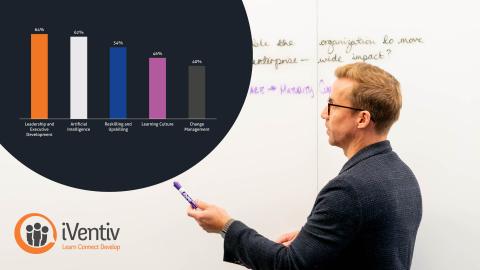
This has been an increasing topic of focus amongst L&D professionals over the past year, with our data showing a rise from 9% to 18% of Global Heads mentioning it as a priority. Arguably, it’s increase in priority reflects several issues: the rapid pace of technological advancements, evolving market conditions, and changing workforce dynamics.
The Role of Leaders and L&D Teams in Effective Change Management
Effective change management, commentators say, not only addresses the structural and procedural aspects of change but also the human element, facilitating a smoother transition for employees and minimising resistance. Scott Cawood (CEO of the non-profit WorldatWork) writing for Forbes Magazine, says that ‘businesses don’t change without the people within the business also changing.’
Does the acceptance of change then lie with leadership?
It is vital, according to an article published by the Harvard Business Review, that leaders demonstrate a commitment to change, and that this commitment trickles down through the organisation because ‘if employees don’t see that the company’s leadership is backing a project, they’re unlikely to change.’
Linking with this is April Rinne (author of Flux: 8 Superpowers for Thriving in Constant Change) who holds the view that ‘change management requires a change mindset.’ In this context, it could be said, L&D teams are instrumental in preparing the workforce for change, equipping them with the necessary skills, knowledge, and mindset. An article by Randstad makes a similar argument that ‘resistance from employees, difficulties with communication, and workforce turnover are all areas where an excellent HR leader can have an impact as a change agent.’
Change Management and Being Future-Ready
Change management and being future-ready seem to go hand-in-hand. On iVentiv’s pre-event surveys, Heads of Learning have asked “how do we prepare for the future of work and enable people to lead through accelerating change?”
In answer to this, Naysan Firoozmand, Head of Global Executive Coaching at Hult EF, says that L&D needs to shift from traditional leadership expertise to a focus on human-centric skills, i.e, ‘human-centric skills that are not regularly trained for or emphasised in traditional career paths.’ This, he says, is vital in not only understanding your workforce, but also encouraging positive change mindsets in employees, and effectively leading through turbulent times.
Employees understandably fear that change will mean many of them losing their jobs, but Lara Albert (Vice President of Solution Marketing, SAP SuccessFactors) writing for Forbes, says that huge changes such as generative AI don’t have to mean job losses. Instead, she suggests that agility in leadership and teams is the key to effective change management and being future-ready, saying that it ‘amplifies a human instinct to learn, adapt, unlearn, and relearn. Agility and continuous learning helps leaders in HR and L&D to ‘alleviate the fear of intelligent technologies – such as machine learning and process automation – by embedding the belief that an individual's potential is unlimited.’
Coursera has made a similar argument around the concept of ‘change agility’, which the company defines as ‘your ability to anticipate and adapt to change.’ Coursera says that change-agile leaders have a greater tolerance for potentially disruptive developments, such as the recent surge in generative AI, stating that these leaders ‘effectively manage change by motivating their employees, strategically planning for new initiatives, and committing to managing setbacks.’
Studies around this topic have shown that change can be a source of anxiety for employees, potentially leading to disengagement and productivity losses. Sara Menke, the Founder and Chief Executive of Premier says that, the reason for this is because change "raises questions about contribution, and they (employees) associate it with negativity."
How, then, can L&D leaders demystify change?
Change Management Done Right
Michael Kerr (president of Humor at Work) suggests “Communication, communication, communication, followed up by more communication” will help leaders to drive positive change in organisations going forward. Employees who are made aware of changes at each stage in the transition, he says, are more likely to embrace new initiatives, contributing positively to their success.
Andrea Belk Olson (Behavioral Scientist, Author, Speaker, Advisor) in support of this, says that ‘when people have actual agency in shaping a change, they are significantly more likely to embrace it.’ Transparent communication helps to build trust and alignment, ensuring that L&D initiatives are well-received and effective.
Others have found that effective change management incorporates a culture that values continuous learning and adaptability. L&D teams play a crucial role in cultivating this, encouraging innovation, and facilitating the exchange of ideas. According to a study by LinkedIn, 94% of employees would stay longer at a company that invests in their learning and development.
Rajiv Jayaraman (Founder and CEO of KNOLSKAPE) argues that, when it comes to L&D, customised learning solutions are the way forward, and that one size does not fit all when it comes to learning. He says ‘to meet with the fast changing needs of the business, learning has to be agile, dynamic and more importantly, intensely personal. Customised training programs, designed to meet the unique needs of different employee groups, experts say, are more effective in building the skills and knowledge required for successful change.
Jorge Rodrigues (President & CEO of Sorenson) makes a similar argument, stating that continuous learning is ‘essential to keep pace and stay attuned to the demands of today's disruptive business climate.’ Organisations with a strong learning culture, he argues, are better positioned to navigate change, as their employees are predisposed to seek out and adapt to new challenges and opportunities.
The Pitfalls of Poor Preparation
The shift from periodical organisational change, to this new era of constantly shifting business dynamics, according to Jorge Rodrigues, is a state ‘not native to the mindset of certain business leaders,’ with many leaders adopting a ‘we’ve always done it this way’ mindset to change. Leaders, he says, need to ‘get out of our proverbial comfort zones and find ways to stay focused on the task of continually directing change within our organizations’ for successful change management to happen.
So what happens when leaders fail to prepare?
Chris Pennington (Consulting Manager at Emerson Human Capital Consulting) says that failing to prepare adequately for change, can have dire consequences for organisations; human beings, he says, are ‘hardwired to resist change […] the amygdala interprets change as a threat and releases the hormones for fear, fight, or flight.’ In this way, our bodies actively try to protect us from it.
This, coupled with the uncertainty and confusion that often accompanies poorly managed change, can lead to a decline in employee morale, with knock-on effects on productivity and quality of work. Without the support of L&D in facilitating understanding and buy-in, experts say, resistance can severely hamper change efforts. Andrea Belk Olson in her article on this topic, says that organisations that handle change the most effectively are those that create ‘a culture of change acceptance, far before they intend to introduce any changes.’
How are you Driving Change?
As the pace of change in the global business environment accelerates, and as Heads of Learning take an increasing interest in how to manage it, the role of Learning and Development in facilitating organisational transformation has never been more critical.
By embracing their strategic role in change management, L&D teams are finding that they can help their organisations navigate the complexities of change with agility and confidence.
The benefits of effective change management, supported by robust L&D initiatives? Enhanced organisational resilience, improved employee engagement, and the cultivation of a learning culture that drives innovation and competitive advantage.
For L&D Leaders, Jay Moore (Chief Learning Officer at GE Corporate, GE) gives two pieces of advice:
- ‘Lead by example and leverage the teams and resources you have available.’
- ‘Be keen on supporting change at the individual and organisational level by acting as a “connector” of the business strategy, capabilities and cultural needs to move people forward.’
The risks of inadequate preparation underscore the importance of L&D's strategic involvement in change initiatives. Through targeted learning interventions, stakeholder engagement, and the strategic use of technology, L&D can ensure that their organisations are not only prepared for the changes ahead but are positioned to thrive in the face of them.