Submitted by networkadmin on
Updated May 2026
By Kerry Summers (Content Marketing Coordinator, iVentiv)
Listen to the podcast on Spotify and Apple Podcasts now
Key Takeaways
- Strategic partnerships expand the impact of executive learning
- High-quality networks shape the future of executive development
- Leaders of the future will need to navigate the rapidly evolving landscape of AI with a blend of humility, adaptability, and critical thinking
- Long-term collaboration builds sustainable value
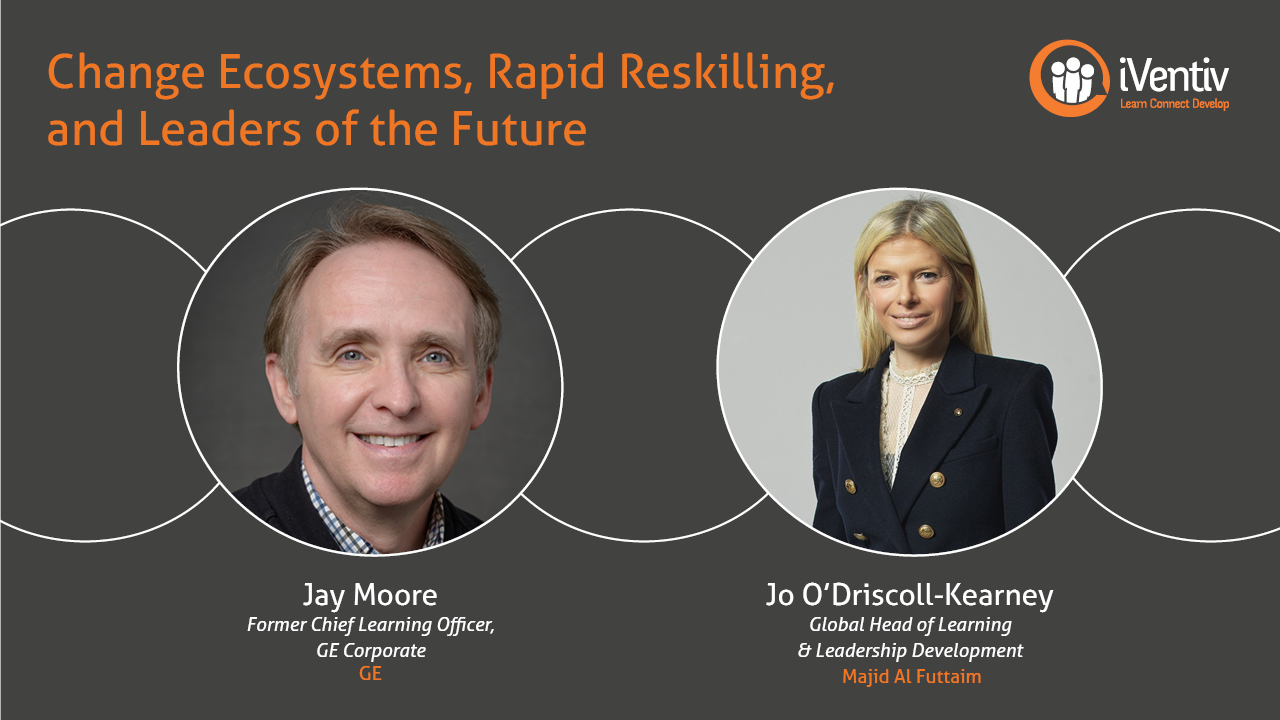
In this insightful interview, Jay Moore, former Chief Learning Officer at GE, and Jo O'Driscoll-Kearney, then Global Head of Learning & Leadership Development at Majid Al Futtaim, delve into the strategies that organisations can adopt to stay competitive in a rapidly changing world.
In a conversation with iVentiv's Hannah Hoey, Jo and Jay discuss how to create ecosystems that continuously re-qualify employees, the role of marketing in Learning & Development, and the importance of fostering a growth-oriented culture.
Join us as we explore the evolving role of leadership in the age of AI, the growing need for adaptability, critical thinking, and the exciting opportunities AI presents for innovation and human connection.
How can organisations develop an ecosystem that constantly re-qualifies employees in line with rapid change?
Organisations, according to Jay Moore and Jo Kearney, can develop an ecosystem that constantly re-qualifies employees by making skill development a strategic priority at the board level, essential for maintaining competitive advantage.
Traditional learning models, they say, are insufficient for the rapidly changing world of work, so it's necessary to establish an ecosystem that continually updates employee skills, addressing the demands of geopolitical, technological, and societal shifts.
Companies should also integrate learning science with rapid skill re-qualification to create resilient and adaptable workforces, something that involves not just meeting current needs but also prepares employees for future challenges by focusing on critical skills like digital literacy and human-centric abilities that are less susceptible to automation.
The pair also advise that collaboration with industry experts and institutions is crucial for staying ahead of trends and ensuring that performance needs analyses are conducted more frequently.
Both Jo and Jay also add that organisations must maintain "epistemic humility", acknowledging the unpredictability of the future and remaining flexible in their learning strategies. Embedding these learning initiatives into regular operational processes and aligning them with the company's strategic goals, they say, ensures they are effectively implemented and continuously reinforced.
Marketing L&D to the organisation - how is it done?
According to Jo and Jay, marketing Learning & Development to an organisation and using L&D to market the organisation are mutually supportive efforts. One approach they mention, is to integrate marketing principles into L&D, treating it as a behaviour change initiative that needs compelling narratives and audience segmentation to make learning relevant and engaging.
Further, by leveraging marketing communication strategies, such as analysing consumption patterns and using multimedia formats, L&D can be effectively communicated within the organisation, not only enhancing learning engagement but also "elevating the perception of L&D as a strategic imperative."
Leaders, they say, also play a crucial role in this process by acting as sponsors and influencers, promoting learning initiatives during key communications. This executive endorsement, they acknowledge, significantly boosts employee engagement with L&D programs. Additionally, aligning L&D with organisational goals and having a cross-functional approach that includes HR, digital technology, and marketing communications ensures that learning is continuously adapted and reinforced.
By marketing L&D effectively within the organisation, both Jo and Jay agree that companies can not only enhance internal learning culture but also use L&D as a tool to showcase their commitment to growth and development, thereby strengthening their external brand.
How can leaders, managers and employees support a growth and learning culture in an organisation?
Leaders, managers, and employees can support a growth and learning culture in an organisation by collectively embracing the responsibility of fostering continuous learning, according to Jo and Jay. This, they say, requires leaders to be advocates who actively promote and participate in learning initiatives, ensuring they are strategically aligned with the organisation's goals.
Managers, it was said, must also serve as allies by facilitating learning opportunities and integrating them into daily work, while employees need to be proactive, taking ownership of their development and sharing knowledge with others.
A learning culture, they say, must be embedded from the recruitment and onboarding process through to career development, with everyone in the organisation contributing to its cultivation. This involves creating networks of peer learning, encouraging mentorship, and utilising various methods like reverse mentoring and guided self-direction.
Leaders should model learning behaviours and establish expectations for employees to not only gain knowledge but also share it, thereby fostering a culture of growth and mutual support.
The success of a learning culture, they emphasise, is evident when employees actively seek out learning opportunities and contribute to the development of their peers, creating a self-sustaining environment where learning is both a personal and organisational priority.
What will leaders of the future need to operate in a world of AI?
To Jo and Jay, leaders of the future will need to navigate the rapidly evolving landscape of AI with a blend of humility, adaptability, and critical thinking.
The fast pace of AI development means that leaders must accept the constant evolution of knowledge and be comfortable admitting knowledge gaps while continuously learning. They must also foster an environment where teams are encouraged to explore AI, share learnings, and experiment with new approaches, all while being mindful of governance and ethical considerations.
Leaders, they state, will need to embrace a mindset of critical reflection, ensuring that AI tools are used responsibly and ethically. According to Jo, AI is "not always ethical by design because sometimes the people training it have bias." Recognising these inherent biases is vital.
As AI increasingly handles lower-level tasks, leaders will need to emphasise the development of critical thinking skills within their teams. The balance between leveraging AI’s benefits and maintaining human oversight and ethical standards, they say, will be crucial. This approach ensures that AI serves to enhance, rather than replace, human judgment and creativity in leadership.
What are you most excited about with AI as an opportunity, be it with Learning or just in general as business leaders?
For Jay, the most exciting opportunity presented by AI is its potential to free people from mundane, administrative tasks, allowing them to "focus on high-value, creative work" that fosters community, connection, and meaningful interactions in the workplace.
Leaders, he says, are enthusiastic about how AI can enable more strategic and empathetic conversations, driving innovation and improving efficiency across various sectors, from healthcare to energy. By reducing the tedium of routine tasks, AI creates space for deeper critical thinking and more purposeful work.
For Jo, the use of AI in areas like content creation, research, and bias elimination can significantly enhance decision-making and the quality of outputs.
However, the realisation of these benefits is still in progress, as the integration of AI into daily work continues to evolve. The aspiration is that AI will ultimately transform workplaces by enabling leaders and employees to engage in more strategic and impactful work, enhancing both personal and organisational growth. This transformation is anticipated by both to bring about a new era of innovation and human connection, making AI a powerful tool for shaping the future of work.
Jo O'Driscoll-Kearney is the global head of leadership development at Majid Al Futtaim and is responsible for setting the strategic direction of the company’s leadership development ambition developing the incredible Majid talent into the leaders needed for tomorrow. Having joined Majid Al Futtaim in 2023, Jo drives innovative and hands-on leadership development programmes to foster an environment of empowerment and growth.
Jay Moore is the former Chief Learning Officer, GE Corporate, where he led global teams responsible for the strategy and delivery of leadership curricula and platforms with oversight of GE’s legacy Corporate University “Crotonville.” Prior to his most recent role in leading the Separation Management Office for learning; Jay worked with several GE businesses which included Healthcare, Corporate, Plastics, Silicones and NBC Universal in the fields of Marketing, Sales, Six Sigma and global Supply Chain.
Frequently Asked Questions
How can organizations ensure continuous re-qualification of employees in the face of rapid change?
Organisations can ensure continuous re-qualification by making skill development a strategic priority at the board level. This involves creating an ecosystem that constantly updates employee skills to address geopolitical, technological, and societal shifts. Integrating learning science with rapid skill re-qualification and collaborating with industry experts are crucial steps in this process.
What role does epistemic humility play in developing a learning ecosystem?
Epistemic humility involves acknowledging the unpredictability of the future and remaining flexible in learning strategies. It requires organizations to admit knowledge gaps and continuously adapt their learning approaches to stay relevant in a rapidly changing environment.
How can marketing principles be applied to Learning & Development?
Marketing principles can be applied to L&D by treating it as a behaviour change initiative that requires compelling narratives and audience segmentation. This approach helps make learning relevant and engaging, which enhances the overall perception of L&D within the organisation.
What is the importance of integrating L&D with organisational goals?
Integrating L&D with organisational goals ensures that learning initiatives are continuously adapted and reinforced. This alignment helps L&D become a strategic imperative within the organisation, thereby enhancing the internal learning culture and strengthening the organisation's external brand.
What skills will leaders of the future need to thrive in an AI-driven world?
Leaders of the future will need humility, adaptability, and critical thinking to navigate the AI-driven world. They must be comfortable with the constant evolution of knowledge, foster an environment that encourages learning and experimentation, and ensure that AI is used responsibly and ethically.