Submitted by networkadmin on
Updated May 2026
By Kerry Summers (Content Marketing Coordinator, iVentiv)
Listen to the podcast on Spotify and Apple Podcasts now
Key Takeaways
- Future skills need a clear, centralised strategy
- Certification gives skills credibility
- Learning culture depends on personal ownership
- Senior leadership support makes learning stick
- Skills-based organisations improve mobility and recruitment
The Skills Journey at T-Systems, and the Role of Certification
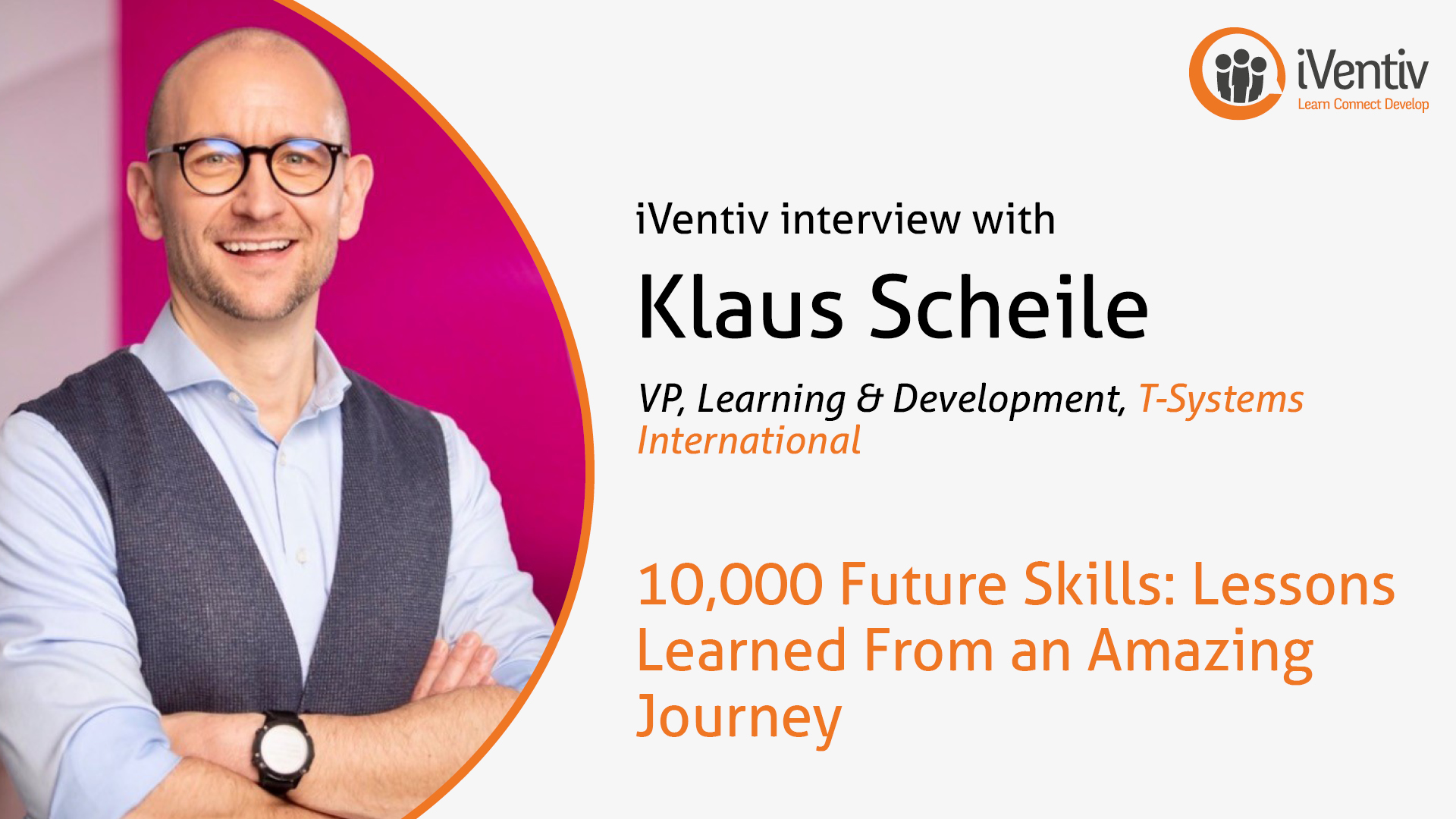
Klaus detailed the strategic approach that T-Systems has taken to addressing the scarcity of skills in the market by centralising Learning & Development to plan effectively for future needs.
Specifically, Klaus tells us that T-Systems aims to certify 10,000 employees in future-oriented tech skills like Docker, Kubernetes, and AI by the end of 2024, with the company close to achieving this goal seven months early.
Why is the certification process at T-Systems so crucial?
- Firstly, it verifies that employees have effectively learned the skills taught in training programs. Klaus mentions that only about one-third of participants achieve certification on average, highlighting the challenge and the rigorous learning required.
- Secondly, obtaining certifications allows individuals to enhance their resumes, reflecting personal investment and accomplishment in skill acquisition.
- Lastly, certifications are vital for maintaining partnerships, as they demonstrate T-Systems' capability and expertise to external stakeholders.
Klaus also discusses operational aspects, noting that T-Systems maintains skill inventories for all 27,000 global employees, tracking each skill and certification which, he stresses, helps to support strategic planning and highlights areas needing focus in skill development and certification efforts.
How Important is Cultivating a Personal Learning Ethos at T-Systems?
Klaus highlighted that Learning & Development are deeply personal choices that each individual must prioritise. He likens it to deciding how much one wants to exercise to stay fit, underscoring that while the company cannot impose learning top-down, it can foster an environment that empowers employees to make those choices for themselves.
T-Systems, he continues, encourages an understanding that there are no limits to what can be learned.
How is T-Systems supporting personal development?
Klaus explains that T-Systems has implemented a dual management structure for its employees: one manager focuses on project-related tasks, while another is dedicated solely to personal development – a structure that underscores the company's commitment to learning.
It's no small wonder that time spent learning at T-Systems has doubled over the past two years.
Doubling-Down on Learning Time: How Important is Senior Leadership in Making That Happen?
Klaus believes that effective learning initiatives require strong support from the top levels of management, including the CEO who, at T-Systems, personally advocates for learning with enthusiasm, quoting a German phrase that translates to "knowledge is power” – a philosophy that is integral to the company's culture.
Building on this, Klaus highlighted the practical measures T-Systems takes to promote learning, such as the annual Learning Hero Award. The winners of this prestigious award are not only recognised for their efforts but are also rewarded to show real appreciation from the top - an approach that not only honours individual achievements but also serves as motivation for others within the organisation.
Skills-Based Organisations, Recruitment, and Klaus’s Own Skills Portfolio
Klaus strongly believes that having a skills-based organisation is foundational for T-Systems, driving much of what they do, especially in connecting learning to skill mobility, talent mobility, and recruitment.
This, he says, is an approach that has enabled T-Systems to be more flexible in staffing and managing talent within the company.
Klaus also shared a significant impact of this strategy on recruitment: initially struggling to attract candidates, they shifted to a "right skilling" approach, offering to train applicants in necessary skills regardless of their background. This strategy led to an overwhelming response, particularly from graduates, with around 4,000 applications for their program.
Why?
Because, he says, candidates were attracted by the company's commitment to invest in their personal and professional development.
From his personal perspective, Klaus is committed to continuous learning and the pursuit knowledge in areas relevant to his professional and personal life. His personal commitment to learning exemplifies the leadership behaviour he advocates within T-Systems, emphasising the importance of senior leaders actively engaging in their own development to lead by example.
Learning Futures Cologne, and the Vital Importance of Collaboration
Klaus took some time to reflect on his experiences at our Learning Futures Cologne event last month (April, 2024), saying that he believes it is extremely important for leaders, particularly in the Learning & Development sector, to come together for networking and sharing experiences.
Why?
- They allow for the honest, open exchange of practical solutions and insights.
- L&D challenges are commonly shared across organisations, and discussing these can lead to immediate and practical solutions.
Klaus highlighted that he found the discussions on reskilling at the event particularly enlightening, illustrating the dual nature of AI's impact on the workforce, and noting that while AI offers significant opportunities, it also poses risks that increase the need for reskilling.
He also highlighted the challenges and responsibilities facing Learning & Development teams as they navigate these changes, underscoring in particular the ongoing efforts to assess the impact of AI, determine which skills will be essential in the future, and understand how to effectively implement reskilling initiatives.
What Advice do you Have for Someone Starting on their Skills Journey?
Klaus offered two main pieces of advice for someone starting on their skills journey:
- Assemble a Passionate Team: he emphasised the importance of having a team that is enthusiastic and passionate about learning. This passion, he says, is crucial as it drives the team forward and sustains them through challenges.
- Engage Senior Leadership: Klaus advised that leaders should start with a strategic workshop involving the board of management. The purpose of this workshop is to set a clear direction and goals for where the organisation wants to be in three years. This engagement, he says, will not only provide a strong foundation and direction but will also empower the team with the necessary support and authority to execute their plans effectively.
Klaus acknowledged that the journey might be tough and tiring at times but stressed that it is ultimately rewarding. His satisfaction, he says, comes from seeing employees develop new skills, possibly moving into new job areas they hadn’t considered before, and embarking on new career paths.
Klaus Scheile is on a mission to make people remarkable, growing the skills and the talent T-Systems needs. As a partner to the business, he reimagines learning strategies from upskilling, re-skilling, career mobility, talent acquisition to the self-learning organisation.
Klaus is passionate about the experience of learning, creating learning journeys that are amazing – and deliver on their promise. Such as the digitise program – a program that delivered over 9.000 future skills for T-Systems.
FAQs
What is the significance of certification processes in tech-based Learning & Development initiatives?
Certification processes are crucial because they validate the skills employees learn during training, boost individual resumes, and demonstrate a company's competency to external stakeholders, thus supporting partnerships and market credibility.
How does a learning-centric culture benefit a tech organisation?
A learning-centric culture empowers employees to develop personally and professionally, encourages continuous skill enhancement, and helps organisations adapt to technological changes and market demands efficiently.
How does a company's investment in Learning & Development affect its attractiveness to potential candidates?
A strong commitment to Learning & Development makes a company more attractive to potential candidates because it signals an investment in employee growth and professional development, appealing especially to those looking to advance their skills and careers.
What advice is offered for someone starting their skills journey in Learning & Development?
Key advice includes assembling a passionate team dedicated to learning and involving senior leadership from the start to set clear strategic directions and goals. This approach ensures the necessary support and authority to execute L&D plans effectively.
Why is collaboration important in the Learning & Development sector?
Collaboration allows leaders to share experiences, discuss common challenges, and discover practical solutions, enhancing the effectiveness of L&D strategies across different organisations and industries.