Why is Coaching a Priority for Talent and Learning Executives?

What is coaching in the workplace? 

According to Parsloe, Coaching is a ‘process that enables Learning and Development to occur, and thus performance to improve.’ (Parsloe, 1999).

Coaching refers to an interaction between two people – a coach, and a coachee, with sessions specifically aimed at performance development. It places emphasis on empowerment, enhancing a coachee’s understanding of their own performance; building their confidence and, in turn, their ability to manage and develop themselves.

In this blog, we’ll explore why coaching is so high on the agenda for L&D, Talent, and Executive Development.
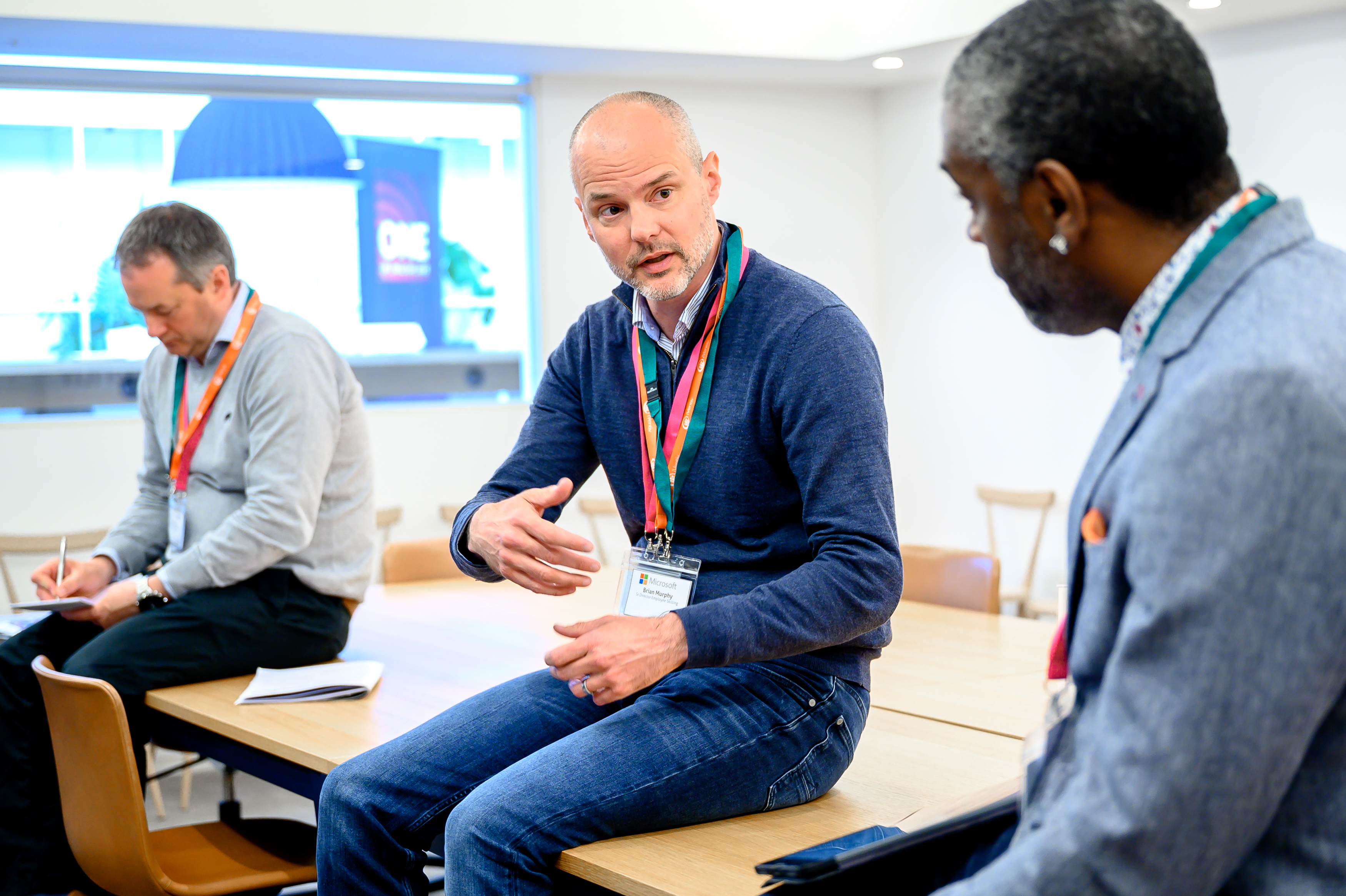
Coaching in action at an iVentiv event

Why are learning, talent, and leadership execs so interested in coaching right now?

For businesses, the recent increase in economic and global uncertainty and ambiguity has called on them to adapt with agility and speed if they want to outpace disruption. 

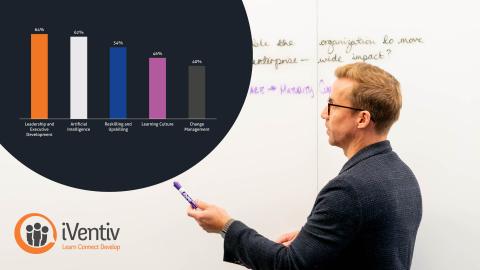
That includes the Global Heads of Learning, Talent, and Leadership who attended iVentiv events over the last year. Before each event, we sent them a questionnaire about their priorities. In the iVentiv Pulse Report, you can see the collated stats from every senior executive who completed those questionnaires. They show that:

  • For the 578 respondents from 435 companies that completed the questionnaire, 17% identified coaching as a key area for their function
  • That was especially true in the US: 23% of respondents in the US, 19% in the UK, and 11% in the rest of Europe selected coaching as a priority 
  • Leadership development was the most selected focus overall, especially for leaders who are interested in coaching: respondents selecting leadership, notably, were much more likely to select coaching as one of their priorities
  • In their comments, they talked about needing to develop “leadership capability” and a “culture of feedback and coaching to elevate talent”

There are several reasons why coaching might be on the minds of so many:

  1. Personalized development: Coaching provides a personalised approach to development, allowing individuals to work on specific goals and challenges in a one-on-one setting. This personalised approach can be especially beneficial for executives who may have unique leadership styles or specific development needs. 
  2. Growing demand: Coaching has become increasingly popular  in recent years (in the US alone, the coaching industry has grown by 30% in five years), and many executives may be interested in exploring this trend to stay competitive and meet the demands of their organisation.
  3. Focus on soft skills: Soft skills such as communication, emotional intelligence, and interpersonal relationships are becoming increasingly important in the workplace, and coaching can be an effective way to develop these skills.
  4. Remote work: With the rise of remote work, coaching can provide a valuable way for executives to stay connected with their teams and maintain a sense of community and support.
  5. Employee retention: Coaching can also be used as a tool to retain top talent by showing a commitment to employee development and growth.

Jay Moore, Global Learning and Culture Leader, GE references the importance of coaching at GE, how the company ‘spends a great deal of time with our most senior leaders for them to be better coaches’ and how it ‘continues to be a needed and necessary skill for leaders’. In essence, it is the tailored approach to development that coaching offers, that can help executives improve their leadership skills and achieve their goals, making it an attractive option for learning, talent, and leadership executives to invest in. 

How is coaching done effectively?

It’s easy to see why coaching might be appealing for learning and talent execs. Leadership is high on the agenda and the widespread understanding that learning from others and learning in work is more effective than classroom teaching means that HR teams are looking to develop talent in a more hands on way. 

Enter coaching. The key thing that many L&D, Talent and Exec Development teams like about coaching is that it is entirely non-directive; coaches are encouraged to limit the giving of advice and to instead focus on assisting coachees   in finding their own solutions to problems.

The theory is that through short, sharp meetings that talk about key goals, progress, and future actions, coaching maximises a coachee’s performance through learning, rather than teaching. It’s an approach designed to develop a coachee’s ability to take responsibility for, not only their own development, but also their performance.

Downey’s (1999) Spectrum of Coaching Skills suggests a number of key attributes of the non-directive coaching approach that sit on the ‘pull’ end of the spectrum (helping someone to solve their own problems):

  • Asking questions to raise awareness
  • Active listening
  • Paraphrasing
  • Summarising
  • Reflecting

By engaging in each of these activities, the coachee gains a sense of autonomy over their own performance, and develops an understanding of what it is they need to do to improve it.

Although it may seem that all of the responsibility to successfully develop employees falls on the coach, the prevailing wisdom is that there is also significant responsibility on the coachee to ensure they achieve their goals, retain knowledge, and apply their experiences. 

David Kolb suggests that while the coach’s role is to assist coachees to move around the experiential learning cycle, it is up to the coachee to actively participate in the process, take responsibility for their own decisions, complete agreed actions, reflect on and review experiences, and manage their own ongoing development. That constant emphasis on practical application to real tasks and real business goals seems to be making coaching all the more appealing.

What are the benefits of coaching?

Learning leaders agree that the overall goal of a coaching session is for the coachee to gain a greater understanding of their own work and how that contributes to the organisation. For many, it not only helps to further learning and solidify it, it gives the coachee dedicated time to focus on performance development, making them more satisfied with and effective in their role.

And the benefits are wide-ranging:

  • Stress reduction
  • Increased motivation
  • Increased confidence
  • Increased self-awareness and self-management skills. 

For the organisation, coaching builds better working relationships in that issues are shared in an environment that is psychologically safe, it enhances the transfer of learning to the workplace as well as the retention of knowledge within the organisation. 

However, while this suggests that effective coaching has a crucial part to play in organisations, coaching advocates also argue that there are barriers that prevent it from being as effective as it could be:

  • Lack of top-down support
  • Resentment felt by those not involved in the scheme or the perception of favouritism
  • The blurring of role boundaries 
  • Leadership and management styles of the organisation – a smaller organisation, for instance, may have more directive approaches to leadership and management, which make the introduction of a different ‘style’ more difficult
  • Cost
  • Coachee commitment

Are you implementing coaching in your organisation? Is it one of your top priorities? Read more about this and the other top priorities for decision makers in learning, talent, and leadership, in the iVentiv Pulse 2023 Report.
 

More Insights

Is scaling leadership in a hypergrowth business just about doing more, faster? Or does it require a fundamental rethink of how leaders operate, how Talent functions deliver value, and how organisations balance structure with agility.

In this conversation with Richard Parfitt, Marketing Director, iVentiv, and Yulia Denisova, VP Talent & Development at Fanatics, we explore what it really takes to build leadership capability at pace in a business that has grown to 20,000 employees across 200 countries. From redefining prioritisation and decision-making, to introducing structure without bureaucracy, Yulia shares how Fanatics is evolving its talent strategy in real time.

The discussion also dives into the role of AI in leadership, the importance of maintaining human connection at scale, and why Learning and Development must shift from control to enablement. Watch the interview now.

As a CLO or Global Head of Learning and Talent, there is no shortage of Learning conferences, events, or webinars that you can attend. There’s a keynote speaker, exhibition stands, and a room full of excited Learning professionals ready and raring to go.

Those events can be a good opportunity to hear case studies and take a whistle-stop tour of what’s happening in the industry. But they aren’t always the best way to take away real, actionable ideas. If you’re in a senior role at a big organisation, especially, you can spend a lot of time speaking to early career attendees from smaller learning teams who aren’t dealing with the same challenges.

But big conferences and ‘sit and listen’ events aren’t the only option for Heads of L&D and Chief Learning Officers. In this blog, we look at how CLOs can take the pulse of the industry, connect with other senior executives, and find solutions to their challenges at collaborative, iVentiv events in locations around the world.

In a world where AI, shifting business priorities, and accelerating change are redefining how organisations develop talent, Learning leaders face a critical question: how do you build a culture where learning truly drives performance? 

In this conversation, William Varsos, Head of Global Learning at Marsh, shares practical insights on embedding learning into the flow of work, aligning development with business strategy, and avoiding the distractions of the latest trends. 

From designing impactful leadership learning to rethinking the role of AI in learning functions, his perspective offers a grounded look at what it really takes to create a sustainable learning culture today. Watch the interview now.

In today’s fast-changing business environment, the biggest Leadership challenge may not be skills, it may be mindset. In this conversation with iVentiv’s Hannah Hoey, Nikhil Shahane, VP Global Head of People Development at TechnipFMC, explores why adaptability, curiosity, and the ability to let go of legacy ways of working are becoming critical Leadership capabilities.

From navigating a “BANI” world to embedding learning in the flow of work, Nikhil shares practical insights on how organisations can shift from skills-focused development to cultivating the mindsets that enable leaders and teams to thrive through constant change. Watch our interview with Nikhil now.
 

In an industry where thousands of frontline employees may be trained in a matter of hours rather than months, hospitality leaders are being forced to rethink how learning, leadership, and communication really work. Many take the view that traditional onboarding, static compliance courses, and one-size-fits-all leadership models simply can’t keep pace with the speed, scale, and expectations of modern hospitality.

In this conversation, David Goddard, VP Talent at Levy Restaurants, shares how one of the world’s leading sports and entertainment hospitality brands is developing leaders that deliver even in the most high-pressure environments. Read the blog now and watch the interview with David to learn more.

As AI rapidly reshapes how work gets done, Leadership Development is facing a defining moment. If knowledge, once the cornerstone of leadership capability, is becoming increasingly commoditised, that could mean that judgement, the ability to make sound decisions, align people, and lead through uncertainty, will matter far more. 

In this interview, Abilitie’s Bjorn Billhardt, Founder and CEO, and Alex Whiteleather, Managing Director for Europe, at Abilitie explore how AI-enabled leadership simulations are transforming development by immersing leaders in realistic, high-stakes decision environments that build critical thinking, business acumen, and cross-functional collaboration.

For Chief Learning and Talent Officers navigating organisational change, flatter structures, and accelerating decision cycles, this perspective could offer a practical framework for rethinking Leadership Development in the age of AI, and a compelling case for why judgement, not knowledge, could provide the true competitive advantage. Watch the interview now and read about how Abilitie is shaking the world of Leadership Development with their brand new Case Challenges experiences.

Artificial Intelligence (AI) has emerged as a powerful force reshaping industries and revolutionising various aspects of our lives. One of the areas where AI is making a significant impact is Learning and Development (L&D).

As organisations strive to stay competitive in a rapidly changing world, many are turning to AI-powered solutions to enhance their training and education programs. 

In this blog, we will explore the nature of AI in Learning and Development initiatives, the key concepts surrounding it, and the challenges L&D leaders are raising when it comes to implementation. Read it now.


Learning, Talent, and Executive Development, and the businesses they serve, are undergoing rapid change. AI is changing the way that employees work and learn. External disruption means that the markets businesses operate in are nothing like they were ten years ago. And the expectations on Learning and Talent leaders are enormous.

As a leader in L&D and Talent, what should you prioritise? iVentiv has surveyed almost 500 Global Heads of Learning, Talent, and Executive Development from 394 companies in 16 cities across 8 countries on three continents to find out what they are focusing on in their work. Together, their views provide a unique perspective on the state of Learning and Talent in 2026.

Read the full report for a detailed breakdown of the top topics, with expert comment from some of the leading thinkers in Learning and Talent Development. In this blog, we share some of the headline takeaways.

In this conversation, iVentiv’s Richard Parfitt (Marketing Director), Hannah Hoey (Content Director), and Kristy Kitson (L&D Strategist) share three key learning and development trends that they predict could shape the 2026 agenda for Chief Learning Officers.

Drawing on insights from conversations with Global Heads of Learning, Talent, and Executive Development across industries, they explore how L&D is moving into organisational design, why skills-based approaches are becoming standard practice, and how the AI conversation is evolving from experimentation to responsible, human-centred integration. 

Informed by conversations with Heads of Learning and Talent at hundreds of companies, this conversation is a unique perspective on what might be in store in 2026 for Learning leaders navigating the future of work. Read the blog now.

Artificial intelligence is no longer a project, an initiative, or a phase of digital transformation. It is fast becoming the environment in which modern organisations operate. 

That is the central message of the Udemy Business Global Learning & Skills Trends Report; a data-rich analysis built from more than 17,000 global enterprises and 85,000 instructors and brought to life in a recent iVentiv interview with Gráinne Wafer, Global Head of Field Enablement at Udemy Business.

For senior executives, the implications are becoming impossible to ignore: AI fluency, not just AI skills, is emerging as the defining strategic capability for the years ahead.

Watch our interview now and read Udemy’s report here.

Pages