The Future of Learning, Talent, and Leadership

Updated March 2026
By Kerry Summers (Content Marketing Coordinator, iVentiv)

Key Takeaways

  • Leadership development is becoming a core lever for business transformation
  • Continuous reskilling is essential as the shelf-life of skills shrinks
  • AI is reshaping corporate learning, but requires responsible integration
  • Experiential and peer-driven learning are replacing traditional leadership programmes
  • A strong learning culture is the foundation of organisational resilience
The world of corporate learning, talent, and leadership is undergoing a period of intense transformation. As organisations strive to build resilient workforces and agile leaders, Chief Learning Officers and Heads of Talent, and Leadership face an array of challenges and opportunities.

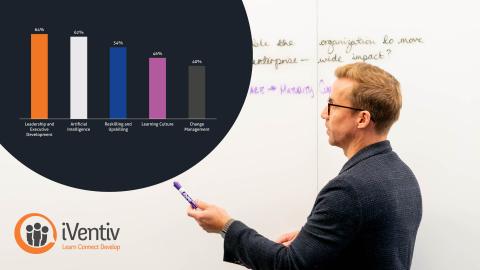
The conversations at iVentiv’s recent Learning Futures sessions in Atlanta and Paris highlight the pressing themes that are shaping the future of workplace learning. Leadership and Executive Development, Reskilling and Upskilling, AI, and Learning Culture were the four most popular priorities identified by Global Heads of Learning at iVentiv events in 2024, so it’s no surprise to see all four represented in the top priorities of attendees at last month’s events as well.

These sessions, attended by senior learning executives, surfaced key trends, strategic shifts, and organisational imperatives that will define 2025 and beyond. 

Leadership & Executive Development: A Strategic Business Imperative

Leadership and Executive Development remain at the forefront of corporate priorities. This was top of mind for 56% of attendees in Paris, and in Atlanta, we saw this climb to 62%. According to participants at both sessions, businesses are increasingly aligning leadership programs with organisational strategy, ensuring leaders are equipped to drive transformation.

Key themes from the discussions included:

  • Visionary Thinking & Agility: Leaders, they said, must anticipate industry shifts and embrace an adaptive mindset.
  • Data-Driven Decision-Making: Balancing data insights with qualitative perspectives remains a challenge, but is critical for leadership effectiveness.
  • Peer-to-Peer Learning & Mentorship: Continuous leadership refinement comes from structured mentorship programs and experiential learning opportunities, say many.

Notably, the debate continues around whether Leadership Development should lead or support business strategy. However, what is clear, based on the outcomes of the conversations, is that CLOs feel leadership initiatives need to evolve beyond traditional approaches and focus on practical, real-world applications.

Reskilling & Upskilling: Crucial for Workforce Transformation

For 52% of leaders in Paris, and 48% of leaders in Atlanta, ‘reskilling and upskilling’ is a topic that continues to resonate. Organisations are experiencing accelerated demand for new skills, learning leaders recognise that the shelf-life of skills is shortening, and there is a growing urgency to embed reskilling and upskilling into the corporate agenda.

Findings from last month’s Executive Knowledge Exchanges suggest that a successful skills strategy hinges on:

  • Clear Skill Taxonomies: Defining skill frameworks and competencies aligned with business objectives.
  • Data-Driven Learning Strategies: Leveraging workforce analytics to assess capability gaps and forecast future skill needs.
  • Embedded Learning in Workflows: Shifting from standalone training initiatives to an integrated skills development culture.

Future-focused skills development, experts say, is not just about keeping pace with change, it is about ensuring workforce adaptability in the face of uncertainty.

Artificial Intelligence in Learning: Balancing Innovation with Ethics

Although AI is the third-most selected topic overall for both cohorts, at 56% the raw percentage is notably higher in France. The group was no more tech-driven than those who gathered in Atlanta, but the high percentage may reflect a genuine drive among French businesses to get ahead with AI, with more than one respondent referring to company-wide technology drives or, in one case, “AI transformation”. 

AI is reshaping the Learning landscape, but its successful integration, for Heads of Learning, requires strategic foresight. Leaders discussed how AI is revolutionising corporate learning and identified key priorities for 2025:

  • Ethical AI Deployment: Maintaining human-centric learning while embracing automation and efficiency.
  • AI-Driven Skills Mapping: Personalising learning experiences through AI-powered skill tagging.
  • Reallocating Freed-Up Capacity: Using AI to automate routine tasks and allow L&D teams to focus on higher-value initiatives.

The use of AI-driven leadership simulations is also growing, providing leaders with immersive, real-world experiences to refine decision-making. Insights from an exclusive session led by iVentiv partner Abilitie shed light on how simulations are transforming leadership learning. They mentioned:

  • AI-Powered Decision-Making: Enabling leaders to test strategies in risk-free environments.
  • Team-Based Challenges: Offering dynamic, real-world business scenarios to build leadership confidence.
  • Blending Technology with Human Interaction: Ensuring that AI enhances leadership learning rather than replacing human judgment.

This shift towards experiential, scenario-based learning underscores a growing demand for practical, high-impact leadership development. One recurring theme was the importance of AI augmentation rather than replacement, ensuring that technology enhances rather than diminishes human engagement.

The Future of Work: Organisational Learning at the Speed of Change

Learning culture has taken the top spot on the priority list for 60% of attendees from our Paris cohort. They said that, to thrive in an era of disruption, organisations must ensure that their learning ecosystems evolve faster than the external environment.

Insights from the iVentiv community pointed to key strategies for achieving this:

  • Fostering a Culture of Curiosity: Creating an environment where learning is continuous and self-directed.
  • Measurement & Impact: Implementing robust metrics to assess the ROI of learning initiatives.
  • Strategic Agility: Embedding learning within business strategy to ensure responsiveness to emerging trends.

Participants also highlighted a paradox: while leaders often question L&D’s impact, they also acknowledge that organisational learning is essential for future resilience. Bridging this gap, the groups said, requires L&D teams to integrate business-first metrics and demonstrate tangible value.

What’s Next for Learning, Talent, and Leadership?

The themes emerging from iVentiv’s Learning Futures exchanges in Atlanta and Paris highlight a transformative moment for corporate Learning, Talent, and Leadership teams.
CLOs and senior leaders are grappling with rapid technological change, shifting workforce expectations, and increasing demands for business alignment.

To navigate this evolving landscape, the experts at both events suggested that organisations must:

  • Align skills strategy with business needs using clear competency frameworks.
  • Enhance Leadership Development with data-driven and qualitative insights.
  • Scale AI-driven solutions through strategic vendor partnerships.
  • Build a learning culture that balances structure with adaptability.

The biggest takeaway from conversations across both events was that the future of Learning & Development will not be defined by incremental improvements, it will be shaped by bold, strategic shifts that reimagine the role of Learning in business success.

As we move into 2025, one thing is certain: the conversation around Learning, Talent, and Leadership is just getting started.
Thumbnail: 
News category: 
Leadership and Executive Development
Reskilling and Upskilling
Artificial Intelligence
Latest Trends in Learning

More Insights

Is scaling leadership in a hypergrowth business just about doing more, faster? Or does it require a fundamental rethink of how leaders operate, how Talent functions deliver value, and how organisations balance structure with agility.

In this conversation with Richard Parfitt, Marketing Director, iVentiv, and Yulia Denisova, VP Talent & Development at Fanatics, we explore what it really takes to build leadership capability at pace in a business that has grown to 20,000 employees across 200 countries. From redefining prioritisation and decision-making, to introducing structure without bureaucracy, Yulia shares how Fanatics is evolving its talent strategy in real time.

The discussion also dives into the role of AI in leadership, the importance of maintaining human connection at scale, and why Learning and Development must shift from control to enablement. Watch the interview now.

As a CLO or Global Head of Learning and Talent, there is no shortage of Learning conferences, events, or webinars that you can attend. There’s a keynote speaker, exhibition stands, and a room full of excited Learning professionals ready and raring to go.

Those events can be a good opportunity to hear case studies and take a whistle-stop tour of what’s happening in the industry. But they aren’t always the best way to take away real, actionable ideas. If you’re in a senior role at a big organisation, especially, you can spend a lot of time speaking to early career attendees from smaller learning teams who aren’t dealing with the same challenges.

But big conferences and ‘sit and listen’ events aren’t the only option for Heads of L&D and Chief Learning Officers. In this blog, we look at how CLOs can take the pulse of the industry, connect with other senior executives, and find solutions to their challenges at collaborative, iVentiv events in locations around the world.

In a world where AI, shifting business priorities, and accelerating change are redefining how organisations develop talent, Learning leaders face a critical question: how do you build a culture where learning truly drives performance? 

In this conversation, William Varsos, Head of Global Learning at Marsh, shares practical insights on embedding learning into the flow of work, aligning development with business strategy, and avoiding the distractions of the latest trends. 

From designing impactful leadership learning to rethinking the role of AI in learning functions, his perspective offers a grounded look at what it really takes to create a sustainable learning culture today. Watch the interview now.

In today’s fast-changing business environment, the biggest Leadership challenge may not be skills, it may be mindset. In this conversation with iVentiv’s Hannah Hoey, Nikhil Shahane, VP Global Head of People Development at TechnipFMC, explores why adaptability, curiosity, and the ability to let go of legacy ways of working are becoming critical Leadership capabilities.

From navigating a “BANI” world to embedding learning in the flow of work, Nikhil shares practical insights on how organisations can shift from skills-focused development to cultivating the mindsets that enable leaders and teams to thrive through constant change. Watch our interview with Nikhil now.
 

In an industry where thousands of frontline employees may be trained in a matter of hours rather than months, hospitality leaders are being forced to rethink how learning, leadership, and communication really work. Many take the view that traditional onboarding, static compliance courses, and one-size-fits-all leadership models simply can’t keep pace with the speed, scale, and expectations of modern hospitality.

In this conversation, David Goddard, VP Talent at Levy Restaurants, shares how one of the world’s leading sports and entertainment hospitality brands is developing leaders that deliver even in the most high-pressure environments. Read the blog now and watch the interview with David to learn more.

As AI rapidly reshapes how work gets done, Leadership Development is facing a defining moment. If knowledge, once the cornerstone of leadership capability, is becoming increasingly commoditised, that could mean that judgement, the ability to make sound decisions, align people, and lead through uncertainty, will matter far more. 

In this interview, Abilitie’s Bjorn Billhardt, Founder and CEO, and Alex Whiteleather, Managing Director for Europe, at Abilitie explore how AI-enabled leadership simulations are transforming development by immersing leaders in realistic, high-stakes decision environments that build critical thinking, business acumen, and cross-functional collaboration.

For Chief Learning and Talent Officers navigating organisational change, flatter structures, and accelerating decision cycles, this perspective could offer a practical framework for rethinking Leadership Development in the age of AI, and a compelling case for why judgement, not knowledge, could provide the true competitive advantage. Watch the interview now and read about how Abilitie is shaking the world of Leadership Development with their brand new Case Challenges experiences.

Artificial Intelligence (AI) has emerged as a powerful force reshaping industries and revolutionising various aspects of our lives. One of the areas where AI is making a significant impact is Learning and Development (L&D).

As organisations strive to stay competitive in a rapidly changing world, many are turning to AI-powered solutions to enhance their training and education programs. 

In this blog, we will explore the nature of AI in Learning and Development initiatives, the key concepts surrounding it, and the challenges L&D leaders are raising when it comes to implementation. Read it now.


Learning, Talent, and Executive Development, and the businesses they serve, are undergoing rapid change. AI is changing the way that employees work and learn. External disruption means that the markets businesses operate in are nothing like they were ten years ago. And the expectations on Learning and Talent leaders are enormous.

As a leader in L&D and Talent, what should you prioritise? iVentiv has surveyed almost 500 Global Heads of Learning, Talent, and Executive Development from 394 companies in 16 cities across 8 countries on three continents to find out what they are focusing on in their work. Together, their views provide a unique perspective on the state of Learning and Talent in 2026.

Read the full report for a detailed breakdown of the top topics, with expert comment from some of the leading thinkers in Learning and Talent Development. In this blog, we share some of the headline takeaways.

In this conversation, iVentiv’s Richard Parfitt (Marketing Director), Hannah Hoey (Content Director), and Kristy Kitson (L&D Strategist) share three key learning and development trends that they predict could shape the 2026 agenda for Chief Learning Officers.

Drawing on insights from conversations with Global Heads of Learning, Talent, and Executive Development across industries, they explore how L&D is moving into organisational design, why skills-based approaches are becoming standard practice, and how the AI conversation is evolving from experimentation to responsible, human-centred integration. 

Informed by conversations with Heads of Learning and Talent at hundreds of companies, this conversation is a unique perspective on what might be in store in 2026 for Learning leaders navigating the future of work. Read the blog now.

Artificial intelligence is no longer a project, an initiative, or a phase of digital transformation. It is fast becoming the environment in which modern organisations operate. 

That is the central message of the Udemy Business Global Learning & Skills Trends Report; a data-rich analysis built from more than 17,000 global enterprises and 85,000 instructors and brought to life in a recent iVentiv interview with Gráinne Wafer, Global Head of Field Enablement at Udemy Business.

For senior executives, the implications are becoming impossible to ignore: AI fluency, not just AI skills, is emerging as the defining strategic capability for the years ahead.

Watch our interview now and read Udemy’s report here.

Pages