Submitted by Kerry Summers on
Updated March 2026
By Kerry Summers (Content Marketing Coordinator, iVentiv)
Key Takeaways
- Modern leadership must balance efficiency with experimentation
- Generative AI is reshaping how learning is designed and delivered
- Learning strategies must clearly link to business performance
- Skills-first talent models support more agile career development
- Human capabilities remain critical in an AI-enabled workplace
In a dynamic and transformative era, the Learning & Development sector is grappling with profound questions about innovation, technology, and leadership. The Learning Hack Podcast, hosted by John Helmer, offers rich insights into these themes through candid conversations with global leaders.
In a recent episode inspired by conversations at iVentiv’s Learning Futures Basel Executive Knowledge Exchange, three thought leaders — Anne-Valérie Corboz (Dean, HEC Paris), Jane Underwood (Global Head of Learning, Reckitt), and Sarah Otley (SVP, Global Head of Akkodis Academy) — came together to share their perspectives on navigating the future of L&D, with discussions covering the evolving nature of leadership, the role of generative AI in L&D, and the enduring challenges of aligning learning strategies with business goals.
Leadership in the Age of Transformation
Anne-Valérie Corboz, Dean at HEC Paris, highlighted a critical tension in leadership: balancing the demand for innovation with maintaining organisational efficiency. "Organisations are typically designed for efficiency," she explained, "but innovation requires exploration—and exploration is inherently inefficient." Her advice for leaders? Embrace a culture of experimentation, failure, and flexibility in order to truly foster innovation.
She also addressed the shift toward empathetic, purpose-led leadership, driven by changing workforce expectations. "The organisation of tomorrow leans more towards being empathetic, agile, and creative," she said, reflecting on how leadership training has evolved to prioritise human-centric approaches.
The Role of Generative AI in Learning
Generative AI has become a pivotal topic for L&D leaders. Anne-Valerie noted that AI is reshaping how educators frame problems, moving away from traditional case studies to more creative and complex problem-solving scenarios. "We have to change the questions we ask and how we ask them," she said, emphasising the need to focus on critical thinking and creativity.
Jane Underwood, Global Head of Learning at Reckitt, shared how her organisation is leveraging AI to prioritise critical skills for the future, saying that "AI is fundamentally changing how we work." She stressed the importance of integrating AI into learning strategies in ways that are practical and relevant to employees' roles, which aligns with her view that modern learning must link directly to business outcomes: "when people see learning as a performance enabler, it stops being something they 'don't have time for' and becomes a priority."
Sarah Otley, SVP, Global Head of Akkodis Academy, picked up a similar theme, addressing the transformative potential of AI in learning delivery, underscoring its dual role in automating mundane tasks and augmenting complex ones. For example, Sarah noted the shift from "content libraries" to "context libraries," where AI curates tailored learning experiences. She went on to say that "AI in delivery excites me the most... it allows us to practice and learn at a scale we've never seen before."
She also shared her framework for preparing organisations for AI:
-
Train First, Tech Later
Ensure employees understand the context and purpose of AI before introducing the tools
-
Task-Level Integration
Focus on automating, augmenting, or adapting tasks rather than overhauling entire roles
-
AI in Delivery
Leverage AI to provide personalised, scalable, and practical learning experiences
Aligning Learning with Business Strategy and Measuring Impact
Jane underscored the importance of aligning L&D initiatives with organisational priorities, saying that “we're looking at how we bring real-world application into our learning," pointing out that measuring the impact of learning is critical. She went on to highlight the growing pressure on L&D to demonstrate ROI, noting, "CEOs want to see the hard data of business impact."
This sentiment was echoed in discussions about creating cultures of continuous improvement rather than standalone learning cultures. Jane advised leaders to "link learning directly to business metrics like project completion rates or customer satisfaction scores," stressing the importance of demonstrating tangible value.
Skills for Tomorrow and a Vision for the Future of Work
The half-life of skills is shortening, creating urgency for organisations to adopt more dynamic, skills-focused approaches. Jane highlighted this shift, saying, "Competency frameworks were rigid and linear, but skills-first approaches allow for cross-functional and cross-business mobility." This adaptability, she believes, is crucial in a world where roles evolve rapidly due to technological advancements.
She highlighted the need for L&D to embrace adaptive frameworks that align closely with business strategies, enabling employees to navigate "squiggly careers" by building transferable skills like problem-solving.
Sarah added that organisations must think strategically about "built, bought, borrowed, or botted" skills, saying that "automation will play a growing role, but we must ensure employees are prepared to adapt and thrive alongside these changes."
Looking ahead, Sarah and Anne-Valérie reflected on the evolving workplace. While AI and digital tools will transform how tasks are performed, the workplace itself will likely shift toward collaboration hubs rather than individual workstations, with the office becoming “a space for collaboration and innovation, where people explore the potential of new tools together."
It is vital, they say, for L&D to adapt to support these changes, and ultimately foster a culture of continuous learning and experimentation that prepares employees for a world where technology and human ingenuity coexist.
Learning Ecosystems and Innovation
Anne-Valérie highlighted the tension between efficiency and exploration in organisational design, which often hinders innovation. She argued that organisations, typically optimised for predictable outcomes, struggle with embracing experimentation and risk, saying that organisations are “designed for efficiency... taking out everything that's exploration because exploration is inefficient."
She went on to emphasise the need for organisations to foster a culture of "failing forward" and create flexible boundaries to integrate external trends and customer-centric approaches. This is particularly vital in industries like education, where digital transformation is reshaping the way learning is designed and delivered.
Both Anne-Valérie and Sarah pointed to a broader shift in how organisations approach learning:
-
Customisation and Personalisation
AI is enabling more tailored learning experiences that align with individual needs and business goals
-
Integration into Workflow
Learning is moving closer to the flow of work, making it more relevant and accessible
-
Emphasis on Human Skills
With AI handling more technical tasks, the focus is shifting to developing leadership, collaboration, and problem-solving capabilities
Making Collaboration and Peer Learning: A Strategic Priority
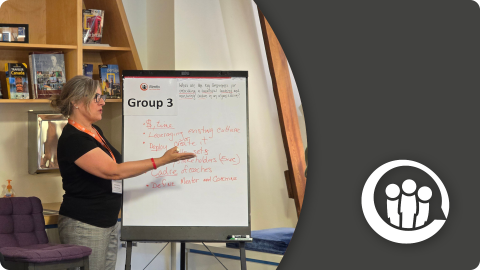
Reflecting on their participation in iVentiv events, Anne-Valérie, Jane, and Sarah highlighted the value of peer-to-peer learning for senior executives. Jane talked about how facilitating sessions on transforming skills at scale through collaborative brainstorming with a group of L&D Heads sparked actionable ideas for her, "networking with peers and sharing knowledge in open conversations is invaluable for shaping strategic initiatives." Sarah echoed this sentiment, particularly appreciating discussions on aligning learning strategies with emerging technologies like AI.
Key Takeaways for L&D Leaders:
-
Embrace Innovation
Cultivate a culture that encourages exploration and experimentation, even if it means disrupting existing norms
-
Leverage AI Wisely
Use AI to enhance learning delivery, create personalised experiences, and automate low-value tasks
-
Focus on Impact
Align learning initiatives with business objectives and measure their tangible contributions to performance
-
Prepare for Change
Equip employees with the skills they need not just for today's challenges but for the evolving demands of the future
-
Adopt Human-Centric Leadership
Foster empathetic, purpose-driven leadership that resonates with a diverse, multigenerational workforce
-
Embrace Collaboration
Create opportunities for peer-to-peer learning and knowledge-sharing within and across organisations
As the podcast came to a close, Anne-Valérie, Jane, and Sarah stated that the future of learning is not about predicting every twist and turn but about equipping organisations with the resilience and adaptability to thrive in an ever-changing world. By aligning strategies with business goals, leveraging emerging technologies, and prioritising human-centric development, L&D leaders can shape a future-ready workforce.
The future of learning is dynamic, diverse, and deeply intertwined with technological innovation. For senior executives in L&D, the challenge lies not in predicting every change but in staying agile, informed, and aligned with both organisational and employee needs. As AI and other technologies continue to evolve, the role of L&D will only grow more pivotal in shaping the workforce of tomorrow.
Watch this episode of The Learning Hack Podcast on YouTube now and click here to read and watch part two of our Learning Hack podcast blog series.
Anne-Valérie Corboz is the Dean of HEC Paris Executive Education and Professor of Leadership. She has extensive global experience, having held senior roles at IMD, Duke, and BCG, and has taught at several top institutions. She holds a Master of Science, an MBA, and a PhD.
With over 25 years of experience, Jane Underwood is a seasoned Learning & Development Director specialising in global talent/development strategies and large-scale transformations that drive business success. Currently the Global Head of Learning at Reckitt, a leading FMCG company, Jane is also an influential voice on LinkedIn, regularly writing and speaking on development and talent management topics.
As SVP, Global Head of Akkodis Academy Sarah is accountable for the development and delivery of tailored reskilling and upskilling programs to future-proof talent and drive workforce transformation. Formerly a front-line management consultant, Sarah Otley is a results-driven senior Learning & Development executive with over 13 years’ experience in learning. Sarah is passionate about creating compelling, relevant learning experiences that deliver measurable business results.