Submitted by Kerry Summers on
Updated March 2026
By Kerry Summers (Content Marketing Coordinator, iVentiv)
Listen to the podcast on Spotify and Apple Podcasts now.
Key Takeaways
- Skills, not competencies, unlock enterprise buy-in
- Anchor skills strategies in business priorities
- Balance personalisation with scalability
- Skills assessment is the next frontier for CLOs
- The future workforce blends human and digital capabilities
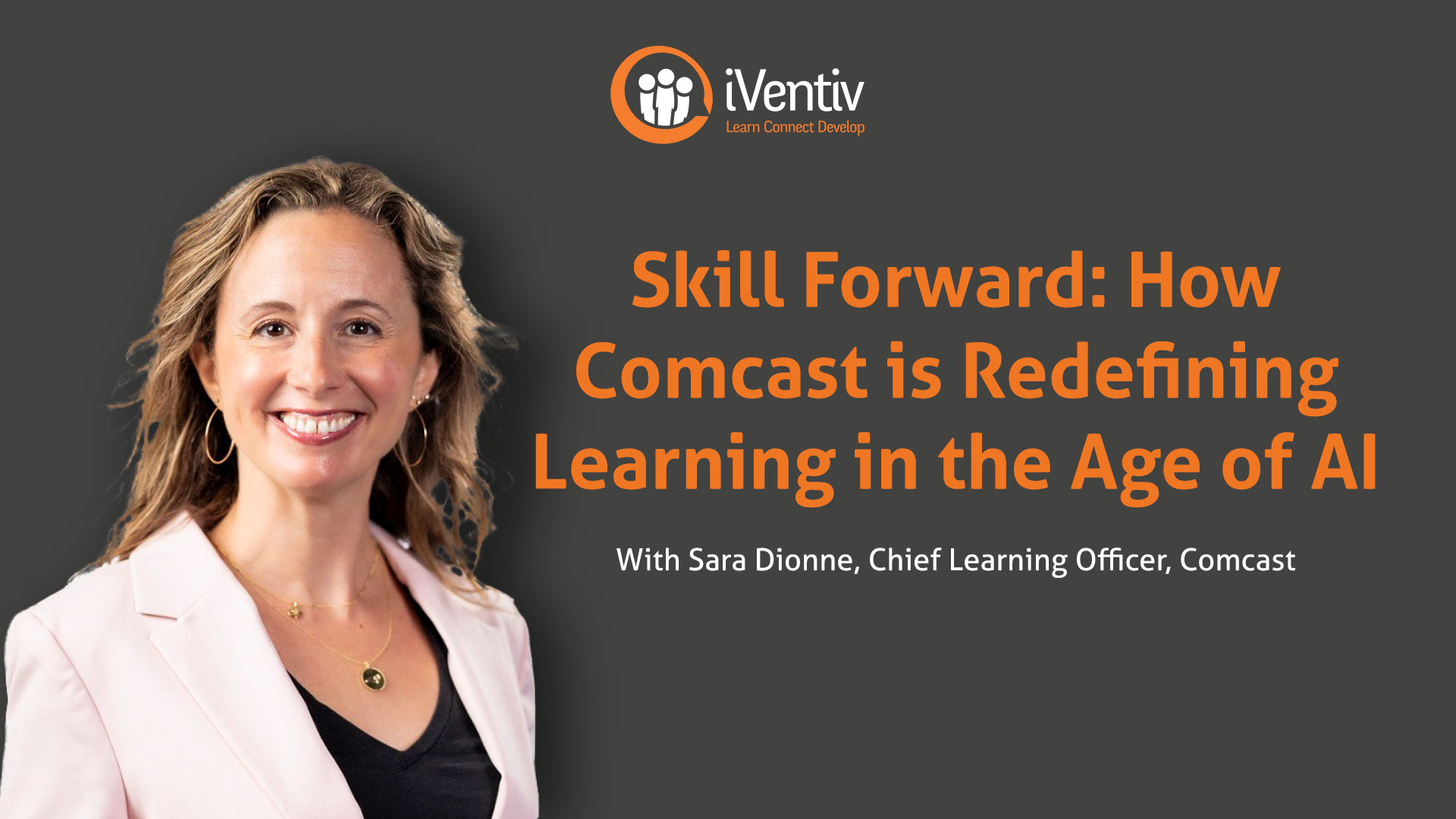
At Comcast, Chief Learning Officer Sara Dionne has been leading a transformation that many L&D leaders will recognise: moving from traditional competency frameworks toward a data-driven, skills-based approach to talent development.
“We branded it Skill Forward,” Sara explains. “We’re about three or four years in now, and this is where we have started building skill-based learning that is completely driven by business priorities. That’s where the data piece comes into play for us.”
From the outset, Sara’s team focused on asking business leaders a simple but powerful question: What do you need to achieve, and what skills will enable that? In year one, just 1,100 leaders participated. Today, more than 3,000 contribute to shaping the company’s skill priorities, alongside insights from hiring data, external research, and corporate strategy.
The Challenge of Scale
Building a skills-based organisation at Comcast’s scale is no small feat. With tens of thousands of employees spread across diverse roles—from frontline technicians to HR specialists to operational managers—the challenge is not simply identifying skills but ensuring that development opportunities feel relevant across such a wide spectrum.
“The biggest challenge we always face,” Sara tells us, “is how do we balance the enterprise-wide need and that consistency with what each business or function needs, with what each individual needs?”
- Sara Dionne, Chief Learning Officer, Comcast
In other words, the central tension lies in balancing personalisation with scalability. Individualised learning journeys are the ideal, but in a matrixed organisation of Comcast’s size, tailoring programmes for every employee is unrealistic. Instead, the company has focused on embedding skills into business operating rhythms, linking development to the natural flow of work.
This means that when new projects, strategies, or changes emerge, the skills most critical to success are introduced at the right moment. Over time, these skills are reinforced, contextualised, and aligned with the broader enterprise strategy.
Why “Skills” Resonates Where Competencies Didn’t
A notable insight from Comcast’s journey is how the language of skills proved more accessible than traditional competency frameworks.
Competencies, Sara tells us, while valuable, can often feel abstract or difficult to pin down. Skills, by contrast, are tangible and relatable. Employees can see them, learn them, and apply them. This clarity has helped secure buy-in not just from senior leaders but also from employees themselves.
“Everyone knows what a skill is,” Sara explained. “Sometimes when we were using competency language, it was a little bit more, where does the competency end or where does it begin? A skill is unique. You add it to your toolkit.”
- Sara Dionne, Chief Learning Officer, Comcast
This subtle but significant shift in language matters. It has allowed Comcast to frame development as something practical and actionable, rather than theoretical or bureaucratic. For employees, skills represent real opportunities to grow. For leaders, they provide a clear lens to assess readiness and capability.
The Problem of Assessment
Sara tells us that identifying and prioritising skills is only half the battle. Measuring them—and doing so at scale—is another challenge entirely.
As Sara pointed out, skills can be acquired quickly through projects, experiences, or short learning bursts. But how can organisations reliably assess whether someone has mastered a skill, or merely been exposed to it? And how do you track those skills across a workforce of thousands?
This issue is magnified by the pace of change. Skills that once lasted a decade may now be relevant for only a year or two. In areas like AI, the landscape can shift in a matter of months. Ensuring assessments keep pace with that change is daunting.
For Sara and Comcast, the focus has turned to exploring how technology can support both personalisation and assessment. The long-term goal is to create systems that not only identify emerging skills but also validate proficiency and track growth over time.
Convergence of Human and Digital Skills
One of the most compelling aspects of Comcast’s journey is its recognition that technical and human skills are no longer distinct categories. Instead, they are converging into integrated capabilities.
For example, AI literacy is critical, but not in isolation. Sara mentions that this must be paired with change agility, collaboration, and trust. Leaders need to understand the technology, but they also need the empathy and adaptability to guide their teams through disruption.
As Sara put it: “If I’m a leader, I need to learn what that technology is. But now I have to navigate the disruption that it’s about to bring. And I need to give confidence to my workforce and bring empathy, because we’re all going to be part of that journey together.”
- Sara Dionne, Chief Learning Officer, Comcast
This blending of human and technical skills reflects the reality of modern work. Employees are not just using tools; they are working with them. In many cases, AI or digital agents are effectively teammates. Building high-performing teams in this context means cultivating both technical fluency and the human capabilities that enable trust, inclusion, and resilience.
Looking Toward 2026: What Skills Matter Most
As Comcast looks ahead, its priorities illustrate how the skills conversation is evolving for organisations everywhere. The focus for 2026, Sara explains, centres on four areas:
1. AI Literacy and Tools
Building not just technical fluency, but also ethical awareness and adaptability to ensure employees use AI responsibly and effectively.
2. Process Optimisation
Developing systems thinking and problem-solving skills to ensure technology investments drive efficiency and value.
3. Vision and Goal Alignment
Equipping leaders to plan strategically, align teams, and foster accountability in an era of constant change.
4. Human and Digital Teaming
Preparing employees to collaborate effectively with AI agents and digital copilots, cultivating a new model of teamwork.
These priorities reflect a shift from narrow skill sets to holistic capabilities that combine technology, leadership, and human connection. They also highlight the need for CLOs to anticipate not just today’s requirements, but the emerging demands of tomorrow.
Lessons for Heads of Learning
Sara’s experience offers several key takeaways for CLOs and senior learning leaders:
Start with the business
Anchor learning programmes in business priorities and engage leaders in defining the skills needed to deliver outcomes.
Scale thoughtfully
Personalisation is critical, but it must be balanced with scalability. Embed skills into business processes and operating rhythms to drive adoption.
Use clear language
Skills resonate more strongly than abstract competencies. Make learning feel tangible and actionable for employees.
Invest in assessment
Reliable, scalable ways to measure skills are essential for credibility and impact. Technology will play a key role here.
Blend human and digital
The future of work is not about technical skills alone. Leaders must also cultivate empathy, adaptability, and inclusion to succeed in a digital-first world.
A Journey, not a Destination
Perhaps the most important insight from Sara’s reflections is that becoming a skills-based organisation is not a one-time project—it is a continuous journey.
As technologies evolve, skills will shift. As business priorities change, development strategies must adapt. And as employees grow, organisations must find new ways to support them.
What makes Comcast’s Skill Forward initiative so impactful is not that it has all the answers, but that it embraces the complexity of the challenge. By treating skills as a living, evolving part of the business, the company has built a foundation that can flex and adapt to whatever the future holds.
For CLOs navigating similar transformations, the message is clear: don’t wait for the perfect model. Start where it matters most to your employees and your business, build momentum, and keep iterating. The skills of tomorrow will not wait.
Sara is a transformational HR Executive with a proven track record of leading enterprise-wide HR, talent, learning, and change strategies for Fortune 20 organizations. Recognized for driving innovation, cultural evolution, and business impact through strategic leadership, operational excellence, and people-first transformation. Currently, Sara is the Chief Learning Officer at Comcast. She leads “ULearn” -- the global learning organization for Comcast. Provide learning leadership and impactful L&D strategies and solutions that enable the continued growth and success of Comcast business goals. Lead team of 300+ L&D experts to deliver learning for 65k employees globally, averaging 2M hours of learning annually.