Reflections on Leadership and GE Crotonville | Doug Scott and Jay Moore

Doug Scott, the former leader of Executive Leadership at GE, and Jay Moore, the Global Learning & Culture Leader at GE Crotonville, spoke with iVentiv about GE’s Corporate University campus at Crotonville, its history, and significance. The two experts shared their experiences and insights on leadership development, the role of emotional intelligence, and the importance of trust in building a culture of collaboration.

Leadership Development at Crotonville: Lessons in Emotional Intelligence and Trust

Crotonville was established in 1956 as a "12-week program on the campus" to train professional managers globally. According to Doug, "Crotonville is about how we do things," and it teaches leaders emotional intelligence and humility. The impact extends beyond its physical location, with satellite programs across the world. Doug explained that "Crotonville wasn't just located north of New York," it had a significant footprint that was real across pretty much every continent in the world.

Doug emphasized the importance of contextual leadership, saying, "different times and needs require different skills." He gave the example of Winston Churchill being the right prime minister during tough times, but not necessarily during times of peace. Jay added to Doug's point, saying, "leaders contextually have to manage through those moments," and that there are things that leaders have to leave behind and things that they have to grab to go forward with, solving for a particular need at a particular time.

Trust is a critical component of Crotonville's success. According to Doug, "one of the critical things that Crotonville has, that really sets it apart, is trust." Big senior leaders running billion-dollar businesses trust Crotonville professionals to add value and help them with cultural change. Jay agreed, saying, "how do you treat and work and build that trust, Doug, that you're describing? I'll tell you, it just makes a tremendous difference." During times of change, trust is critical, as it can either be a roadblock or accelerate the agenda. GE has built a tremendous amount of trust over the years, allowing teams to work together effectively during times of change.

Rankless Nature and Safe Spaces: What Makes Crotonville Unique?

Jay and Doug explained that one of the things that made Crotonville unique was its rankless nature, where senior leaders can sit at the same table with the newest, most junior person in the company. This allows for more relaxed conversations, accelerating learning, and helping with change. Jay praised the listening, engagement, and invested skills of good learning organizations, which help to eliminate blind spots for leaders who may not be seeing their message or strategy resonate throughout the company.

Doug shared the story of a class on emotional intelligence, where he asked participants to take an hour every morning to turn off from work and focus on themselves. Jay talked about the "Leader in Residence" program, which brought senior leaders to the campus to immerse themselves in classes and engage with participants. Jay noted that this program was so successful that it was taken virtual, and that leaders often gained just as much as the participants did from the experience.

Doug and Jay talked about how Crotonville fosters trust and understanding among employees. Doug noted that "the structure of Crotonville...is kind of...a secret sauce of, 'this is how stuff's done.'" He also emphasized the importance of vulnerability in building trust, and how the safe space at Crotonville helped employees unpack their barriers. Jay mentioned the strong engineering and continuous improvement culture at GE, and how these cultures align with Crotonville's values.

The Impact of Technology on Leadership Development: Challenges and Opportunities

Doug and Jay also touched on the impact of technology on leadership development. Doug noted that while technology has made certain aspects of leadership development easier, such as virtual learning and the ability to access information quickly, it also poses challenges in terms of maintaining human connection and building trust. Jay added that technology can also create a disconnect between leaders and their teams, as leaders may not be aware of what is happening on the ground. He emphasized the importance of leaders staying connected and engaged with their teams, even in a virtual setting.

As Doug puts it, "I do think it's that hybrid piece of learning, it's just like the hybrid piece of how many days do we go to the office each week." While technology has posed challenges in terms of maintaining human connection and building trust, it has also provided opportunities for virtual learning and quick access to information. As Jay explains, learning and leadership teams like his team at GE are getting better at recognising and “defining those moments” where the efficiency and reach of the virtual is valuable.

In a world where change is constant and complex, Crotonville has provided leaders with the tools and skills they need to navigate through these challenges. As Doug notes, "there are different times, there are different environments, and there are different places, companies and governments and countries are going in... different times and needs require different skills." 

Overall, Crotonville has been a critical component of GE's success, and has contributed to the development of countless successful leaders. As Jay notes, "at the end of the day, it's all about people, and it's all about building a better world." Crotonville has been instrumental in building better leaders, and in turn, building a better world.

iVentiv will be back at Crotonville later this year for Executive Development New York. Find out more about how to get involved here.

Doug Scott is the Former Leader of Executive Leadership at GE, with over 30 years of experience in leadership roles at the company. He has been instrumental in developing and implementing leadership development programs at GE, including Crotonville. Jay Moore is the Global Learning & Culture Leader at GE Crotonville, responsible for driving GE's learning and development strategy. He has over 25 years of experience in learning and development, and has been a key contributor to the success of Crotonville.
 

More Insights

Is scaling leadership in a hypergrowth business just about doing more, faster? Or does it require a fundamental rethink of how leaders operate, how Talent functions deliver value, and how organisations balance structure with agility.

In this conversation with Richard Parfitt, Marketing Director, iVentiv, and Yulia Denisova, VP Talent & Development at Fanatics, we explore what it really takes to build leadership capability at pace in a business that has grown to 20,000 employees across 200 countries. From redefining prioritisation and decision-making, to introducing structure without bureaucracy, Yulia shares how Fanatics is evolving its talent strategy in real time.

The discussion also dives into the role of AI in leadership, the importance of maintaining human connection at scale, and why Learning and Development must shift from control to enablement. Watch the interview now.

As a CLO or Global Head of Learning and Talent, there is no shortage of Learning conferences, events, or webinars that you can attend. There’s a keynote speaker, exhibition stands, and a room full of excited Learning professionals ready and raring to go.

Those events can be a good opportunity to hear case studies and take a whistle-stop tour of what’s happening in the industry. But they aren’t always the best way to take away real, actionable ideas. If you’re in a senior role at a big organisation, especially, you can spend a lot of time speaking to early career attendees from smaller learning teams who aren’t dealing with the same challenges.

But big conferences and ‘sit and listen’ events aren’t the only option for Heads of L&D and Chief Learning Officers. In this blog, we look at how CLOs can take the pulse of the industry, connect with other senior executives, and find solutions to their challenges at collaborative, iVentiv events in locations around the world.

In a world where AI, shifting business priorities, and accelerating change are redefining how organisations develop talent, Learning leaders face a critical question: how do you build a culture where learning truly drives performance? 

In this conversation, William Varsos, Head of Global Learning at Marsh, shares practical insights on embedding learning into the flow of work, aligning development with business strategy, and avoiding the distractions of the latest trends. 

From designing impactful leadership learning to rethinking the role of AI in learning functions, his perspective offers a grounded look at what it really takes to create a sustainable learning culture today. Watch the interview now.

In today’s fast-changing business environment, the biggest Leadership challenge may not be skills, it may be mindset. In this conversation with iVentiv’s Hannah Hoey, Nikhil Shahane, VP Global Head of People Development at TechnipFMC, explores why adaptability, curiosity, and the ability to let go of legacy ways of working are becoming critical Leadership capabilities.

From navigating a “BANI” world to embedding learning in the flow of work, Nikhil shares practical insights on how organisations can shift from skills-focused development to cultivating the mindsets that enable leaders and teams to thrive through constant change. Watch our interview with Nikhil now.
 

In an industry where thousands of frontline employees may be trained in a matter of hours rather than months, hospitality leaders are being forced to rethink how learning, leadership, and communication really work. Many take the view that traditional onboarding, static compliance courses, and one-size-fits-all leadership models simply can’t keep pace with the speed, scale, and expectations of modern hospitality.

In this conversation, David Goddard, VP Talent at Levy Restaurants, shares how one of the world’s leading sports and entertainment hospitality brands is developing leaders that deliver even in the most high-pressure environments. Read the blog now and watch the interview with David to learn more.

As AI rapidly reshapes how work gets done, Leadership Development is facing a defining moment. If knowledge, once the cornerstone of leadership capability, is becoming increasingly commoditised, that could mean that judgement, the ability to make sound decisions, align people, and lead through uncertainty, will matter far more. 

In this interview, Abilitie’s Bjorn Billhardt, Founder and CEO, and Alex Whiteleather, Managing Director for Europe, at Abilitie explore how AI-enabled leadership simulations are transforming development by immersing leaders in realistic, high-stakes decision environments that build critical thinking, business acumen, and cross-functional collaboration.

For Chief Learning and Talent Officers navigating organisational change, flatter structures, and accelerating decision cycles, this perspective could offer a practical framework for rethinking Leadership Development in the age of AI, and a compelling case for why judgement, not knowledge, could provide the true competitive advantage. Watch the interview now and read about how Abilitie is shaking the world of Leadership Development with their brand new Case Challenges experiences.

Artificial Intelligence (AI) has emerged as a powerful force reshaping industries and revolutionising various aspects of our lives. One of the areas where AI is making a significant impact is Learning and Development (L&D).

As organisations strive to stay competitive in a rapidly changing world, many are turning to AI-powered solutions to enhance their training and education programs. 

In this blog, we will explore the nature of AI in Learning and Development initiatives, the key concepts surrounding it, and the challenges L&D leaders are raising when it comes to implementation. Read it now.


Learning, Talent, and Executive Development, and the businesses they serve, are undergoing rapid change. AI is changing the way that employees work and learn. External disruption means that the markets businesses operate in are nothing like they were ten years ago. And the expectations on Learning and Talent leaders are enormous.

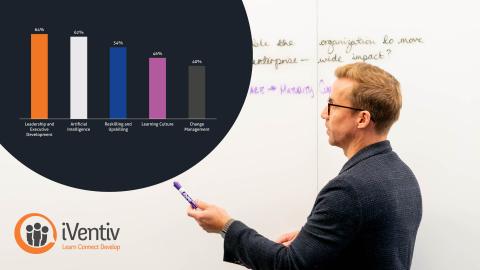
As a leader in L&D and Talent, what should you prioritise? iVentiv has surveyed almost 500 Global Heads of Learning, Talent, and Executive Development from 394 companies in 16 cities across 8 countries on three continents to find out what they are focusing on in their work. Together, their views provide a unique perspective on the state of Learning and Talent in 2026.

Read the full report for a detailed breakdown of the top topics, with expert comment from some of the leading thinkers in Learning and Talent Development. In this blog, we share some of the headline takeaways.

In this conversation, iVentiv’s Richard Parfitt (Marketing Director), Hannah Hoey (Content Director), and Kristy Kitson (L&D Strategist) share three key learning and development trends that they predict could shape the 2026 agenda for Chief Learning Officers.

Drawing on insights from conversations with Global Heads of Learning, Talent, and Executive Development across industries, they explore how L&D is moving into organisational design, why skills-based approaches are becoming standard practice, and how the AI conversation is evolving from experimentation to responsible, human-centred integration. 

Informed by conversations with Heads of Learning and Talent at hundreds of companies, this conversation is a unique perspective on what might be in store in 2026 for Learning leaders navigating the future of work. Read the blog now.

Artificial intelligence is no longer a project, an initiative, or a phase of digital transformation. It is fast becoming the environment in which modern organisations operate. 

That is the central message of the Udemy Business Global Learning & Skills Trends Report; a data-rich analysis built from more than 17,000 global enterprises and 85,000 instructors and brought to life in a recent iVentiv interview with Gráinne Wafer, Global Head of Field Enablement at Udemy Business.

For senior executives, the implications are becoming impossible to ignore: AI fluency, not just AI skills, is emerging as the defining strategic capability for the years ahead.

Watch our interview now and read Udemy’s report here.

Pages