What are the Top Priorities for Chief Learning and Talent Officers in the First Half of 2024?

iVentiv has spent the first six months of 2024 asking Global Heads of Learning, Talent, and Leadership to share the top priorities and challenges for their function right now.

In this blog, we explore the results, with some preliminary exploration of what the figures tell us about the work of L&D teams across the world right now.

What are the Top Priorities for Learning and Talent Right Now?

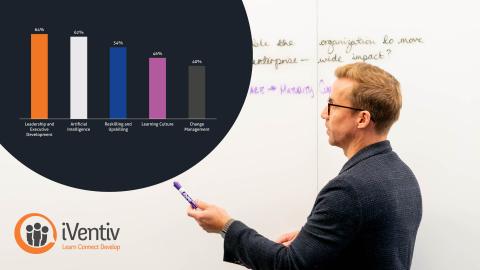
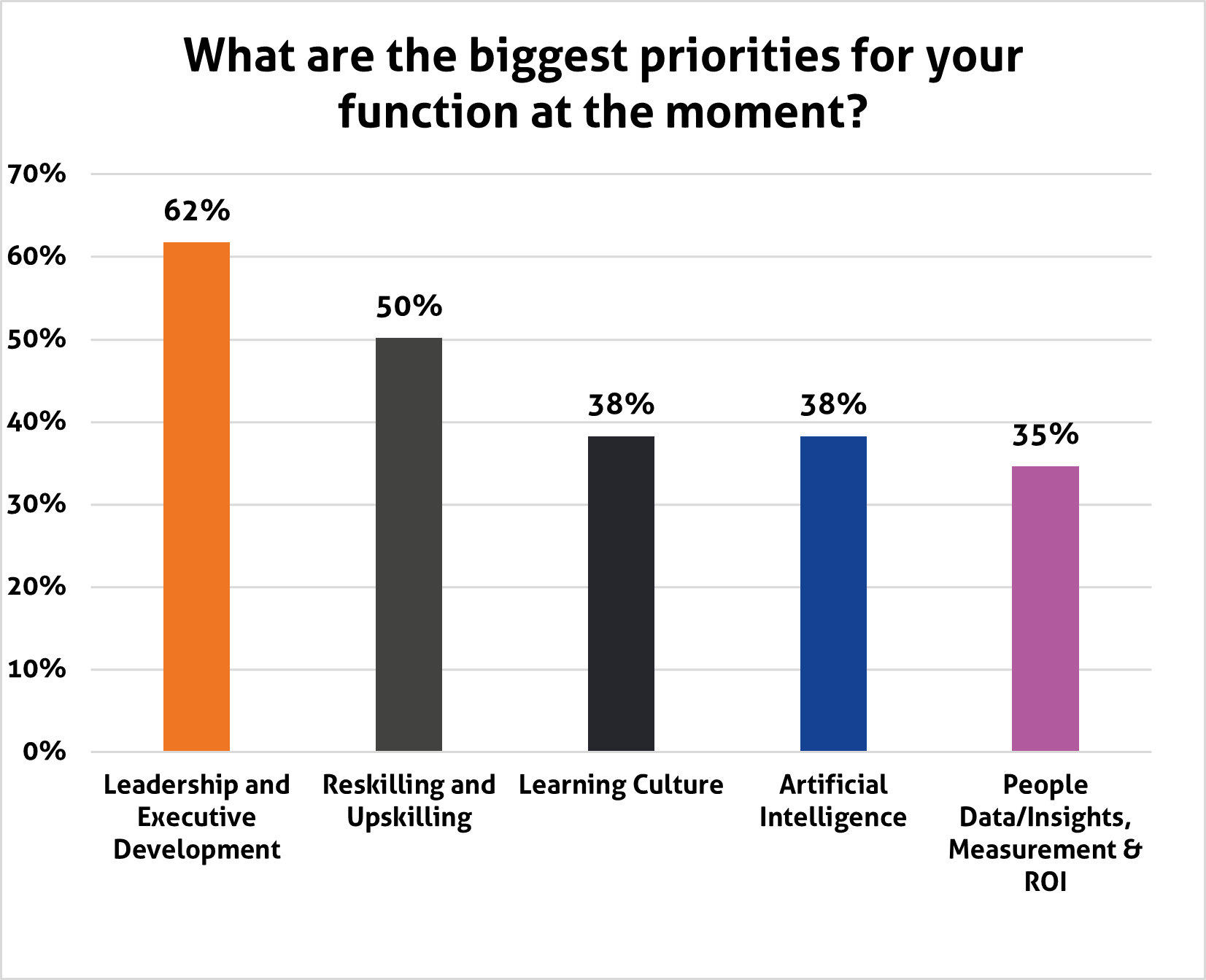
At the end of 2023, the most popular area highlighted by respondents was Leadership and Executive Development. So far in 2024, more than 300 C-suite executives, all leading L&D and Talent functions for Global organisations, have responded. We can now reveal that the top priorities for the year to date (with changes since the start of the year) are:
Biggest priorities for Learning and Talent leaders on a bar chart

  • Leadership and Executive Development: 62% (+6) 
  • Reskilling and Upskilling: 50% (+5) 
  • Learning Culture: 38% (-1) 
  • Artificial Intelligence: 38% (+11) 
  • People Data/Insights, Measurement and ROI: 35% (+8) 

Leadership and Executive Development remains the most selected topic, as it has been since iVentiv started tracking these numbers in 2022. Along with Reskilling and Upskilling, the percentage of respondents selecting Leadership has only risen since the start of the year.

Learning Culture remains the third most selected topic, with the proportion largely unchanged, ahead of Artificial Intelligence. AI was previously included with ‘Learning Technologies’ including LXPs and Virtual Reality. We made it a standalone category this year and the growth in interest reflects that methodological change, though an 11-percentage point rise is still striking. People Data/Insights, Measurement, and ROI drop from fourth to fifth position, but the percentage itself is still up significantly.

Why Isn’t AI Top?

Several surveys of L&D professionals have put AI as the runaway top topic of interest. In that sense, this survey is an outlier. The difference likely lies in the question and the sample. On the one hand, this survey asks for current top priorities. Others ask respondents to predict the biggest trends, a no less valid question to ask. Nonetheless, by asking about current priorities, this survey is more likely to focus attention on the actual work being done.

The seniority of respondents may also play a role. Leadership, skills, and culture, notably, are top-level strategic questions. AI, arguably, will impact junior colleagues’ work more directly, thus broader surveys of L&D professionals (as opposed to leaders) are more likely to capture AI users rather than strategic leaders. 

That is reflected in the discrepancy between L&D leaders and Executive Development/Talent Management leaders:
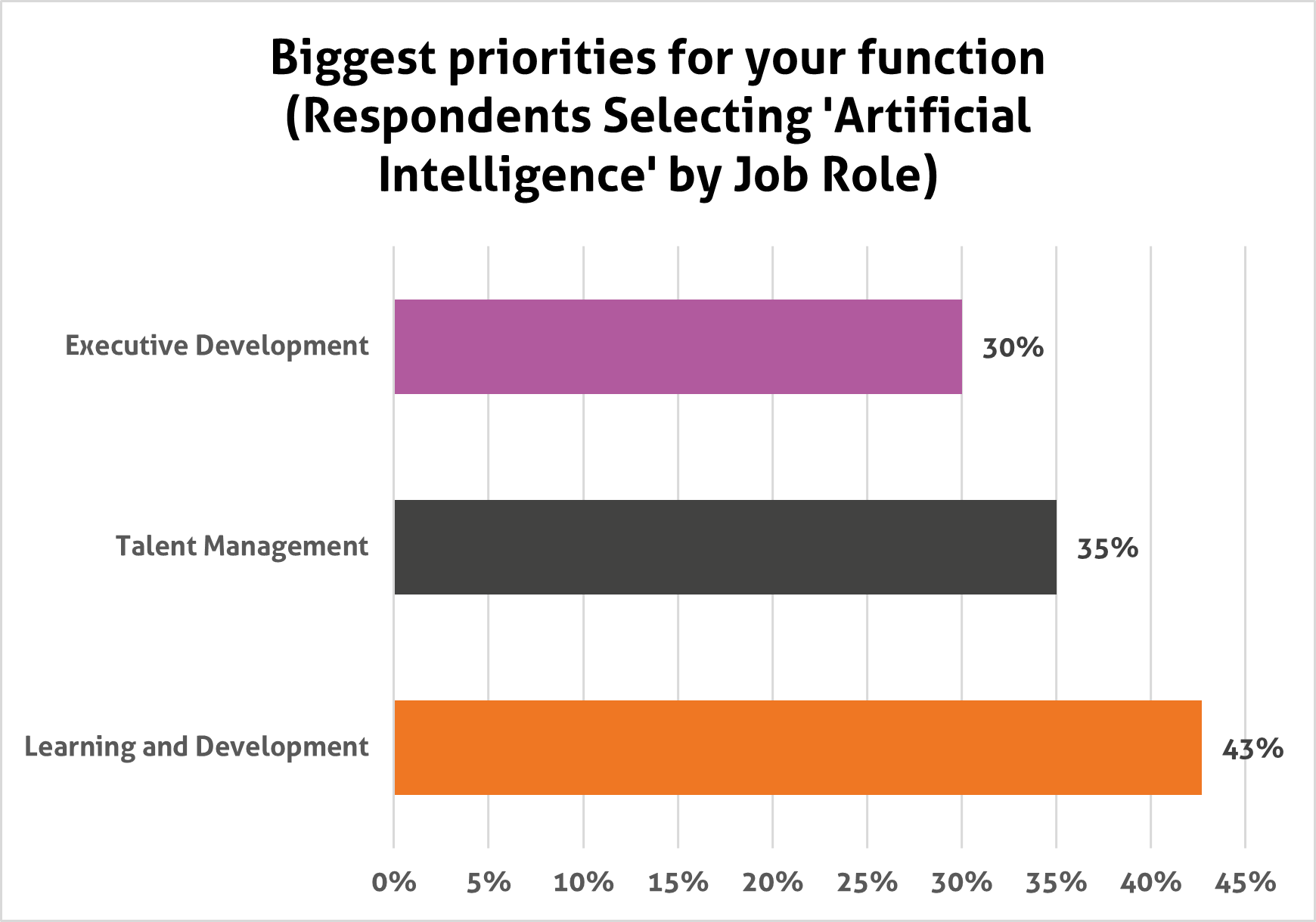
A graph showing that only 30% of Exec Development and 35% of Talent Management leaders highlighted AI as a priority, compared to 43% in L&D

Whereas L&D specialists are concerned about the applications for both the business broadly and the Learning function more specifically, when it comes to HiPo and Executive Development those concerns are less acute. Learning leaders reference using “generative AI for better learning solutions” and “leveraging artificial intelligence to harvest knowledge from communities of practice for basic e-learning.” These are clearly Learning goals rather than business-level priorities.

Leadership, Culture, Skills and Tech Go Hand-in-Hand

AI for AI’s sake may not be a priority, therefore, but new technology is still a key factor behind the leadership and skills agenda. Respondents report working to help “end users adopt new technologies and ways of working”, with leaders needing to be role models for “culture change” in the “conversion to a skills-based organisation.”

Change, even when putting technology aside, is a recurring theme. Change Management has itself been the sixth most selected subject so far this year. For some, that is about internal factors such as a "planned conversion to a skills-based organisation.” For others, it is about external factors in a VUCA world, with more than one respondent referencing “difficult external headwinds” including the “election year” and “global context.” 

Building agility by creating a “culture of lifelong learning” has therefore been top of the agenda for Learning executives. Business leaders set the culture, the culture drives continuous skills improvement, and the role of technology is to enable that. Put another way, skills are the What, AI is the How.

Good Data Enables L&D to Solve Business Problems

Data is the fifth of our five focus topics in this blog, but the importance of “People Data/Insights, Measurement and ROI” has seen significant growth (eight percentage points) in the past six months. The combination of AI and the scramble for “skills-based” solutions means that Learning teams are seeking out high-quality data to support “skills mapping” and “Talent Marketplace solutions” for more effective “skills identification and assessment.”

While some still ask “should organisations move to a skills-based [approach],” others are proceeding with more certainty. Establishing “metrics” to feed those initiatives, “measure success,” and “make it work beyond identification of talents” is a significant part of their approach.

Conclusion: L&D is Solving Business Problems

The focus on data and ROI reflects, in part, a continuing anxiety about L&D’s ability to solve business problems, but this data suggests that Learning leaders remain focused on the top-level issues that drive business performance. Rather than pursuing the latest shiny platform, Chief Learning Officers are interrogating new technologies – whether AI-generated content or complex skills mapping – to understand the data that feeds them and how they, in turn, support the leadership, culture, and skills that the business needs to succeed. 
More Insights

Is scaling leadership in a hypergrowth business just about doing more, faster? Or does it require a fundamental rethink of how leaders operate, how Talent functions deliver value, and how organisations balance structure with agility.

In this conversation with Richard Parfitt, Marketing Director, iVentiv, and Yulia Denisova, VP Talent & Development at Fanatics, we explore what it really takes to build leadership capability at pace in a business that has grown to 20,000 employees across 200 countries. From redefining prioritisation and decision-making, to introducing structure without bureaucracy, Yulia shares how Fanatics is evolving its talent strategy in real time.

The discussion also dives into the role of AI in leadership, the importance of maintaining human connection at scale, and why Learning and Development must shift from control to enablement. Watch the interview now.

As a CLO or Global Head of Learning and Talent, there is no shortage of Learning conferences, events, or webinars that you can attend. There’s a keynote speaker, exhibition stands, and a room full of excited Learning professionals ready and raring to go.

Those events can be a good opportunity to hear case studies and take a whistle-stop tour of what’s happening in the industry. But they aren’t always the best way to take away real, actionable ideas. If you’re in a senior role at a big organisation, especially, you can spend a lot of time speaking to early career attendees from smaller learning teams who aren’t dealing with the same challenges.

But big conferences and ‘sit and listen’ events aren’t the only option for Heads of L&D and Chief Learning Officers. In this blog, we look at how CLOs can take the pulse of the industry, connect with other senior executives, and find solutions to their challenges at collaborative, iVentiv events in locations around the world.

In a world where AI, shifting business priorities, and accelerating change are redefining how organisations develop talent, Learning leaders face a critical question: how do you build a culture where learning truly drives performance? 

In this conversation, William Varsos, Head of Global Learning at Marsh, shares practical insights on embedding learning into the flow of work, aligning development with business strategy, and avoiding the distractions of the latest trends. 

From designing impactful leadership learning to rethinking the role of AI in learning functions, his perspective offers a grounded look at what it really takes to create a sustainable learning culture today. Watch the interview now.

In today’s fast-changing business environment, the biggest Leadership challenge may not be skills, it may be mindset. In this conversation with iVentiv’s Hannah Hoey, Nikhil Shahane, VP Global Head of People Development at TechnipFMC, explores why adaptability, curiosity, and the ability to let go of legacy ways of working are becoming critical Leadership capabilities.

From navigating a “BANI” world to embedding learning in the flow of work, Nikhil shares practical insights on how organisations can shift from skills-focused development to cultivating the mindsets that enable leaders and teams to thrive through constant change. Watch our interview with Nikhil now.
 

In an industry where thousands of frontline employees may be trained in a matter of hours rather than months, hospitality leaders are being forced to rethink how learning, leadership, and communication really work. Many take the view that traditional onboarding, static compliance courses, and one-size-fits-all leadership models simply can’t keep pace with the speed, scale, and expectations of modern hospitality.

In this conversation, David Goddard, VP Talent at Levy Restaurants, shares how one of the world’s leading sports and entertainment hospitality brands is developing leaders that deliver even in the most high-pressure environments. Read the blog now and watch the interview with David to learn more.

As AI rapidly reshapes how work gets done, Leadership Development is facing a defining moment. If knowledge, once the cornerstone of leadership capability, is becoming increasingly commoditised, that could mean that judgement, the ability to make sound decisions, align people, and lead through uncertainty, will matter far more. 

In this interview, Abilitie’s Bjorn Billhardt, Founder and CEO, and Alex Whiteleather, Managing Director for Europe, at Abilitie explore how AI-enabled leadership simulations are transforming development by immersing leaders in realistic, high-stakes decision environments that build critical thinking, business acumen, and cross-functional collaboration.

For Chief Learning and Talent Officers navigating organisational change, flatter structures, and accelerating decision cycles, this perspective could offer a practical framework for rethinking Leadership Development in the age of AI, and a compelling case for why judgement, not knowledge, could provide the true competitive advantage. Watch the interview now and read about how Abilitie is shaking the world of Leadership Development with their brand new Case Challenges experiences.

Artificial Intelligence (AI) has emerged as a powerful force reshaping industries and revolutionising various aspects of our lives. One of the areas where AI is making a significant impact is Learning and Development (L&D).

As organisations strive to stay competitive in a rapidly changing world, many are turning to AI-powered solutions to enhance their training and education programs. 

In this blog, we will explore the nature of AI in Learning and Development initiatives, the key concepts surrounding it, and the challenges L&D leaders are raising when it comes to implementation. Read it now.


Learning, Talent, and Executive Development, and the businesses they serve, are undergoing rapid change. AI is changing the way that employees work and learn. External disruption means that the markets businesses operate in are nothing like they were ten years ago. And the expectations on Learning and Talent leaders are enormous.

As a leader in L&D and Talent, what should you prioritise? iVentiv has surveyed almost 500 Global Heads of Learning, Talent, and Executive Development from 394 companies in 16 cities across 8 countries on three continents to find out what they are focusing on in their work. Together, their views provide a unique perspective on the state of Learning and Talent in 2026.

Read the full report for a detailed breakdown of the top topics, with expert comment from some of the leading thinkers in Learning and Talent Development. In this blog, we share some of the headline takeaways.

In this conversation, iVentiv’s Richard Parfitt (Marketing Director), Hannah Hoey (Content Director), and Kristy Kitson (L&D Strategist) share three key learning and development trends that they predict could shape the 2026 agenda for Chief Learning Officers.

Drawing on insights from conversations with Global Heads of Learning, Talent, and Executive Development across industries, they explore how L&D is moving into organisational design, why skills-based approaches are becoming standard practice, and how the AI conversation is evolving from experimentation to responsible, human-centred integration. 

Informed by conversations with Heads of Learning and Talent at hundreds of companies, this conversation is a unique perspective on what might be in store in 2026 for Learning leaders navigating the future of work. Read the blog now.

Artificial intelligence is no longer a project, an initiative, or a phase of digital transformation. It is fast becoming the environment in which modern organisations operate. 

That is the central message of the Udemy Business Global Learning & Skills Trends Report; a data-rich analysis built from more than 17,000 global enterprises and 85,000 instructors and brought to life in a recent iVentiv interview with Gráinne Wafer, Global Head of Field Enablement at Udemy Business.

For senior executives, the implications are becoming impossible to ignore: AI fluency, not just AI skills, is emerging as the defining strategic capability for the years ahead.

Watch our interview now and read Udemy’s report here.

Pages